Wonder of America
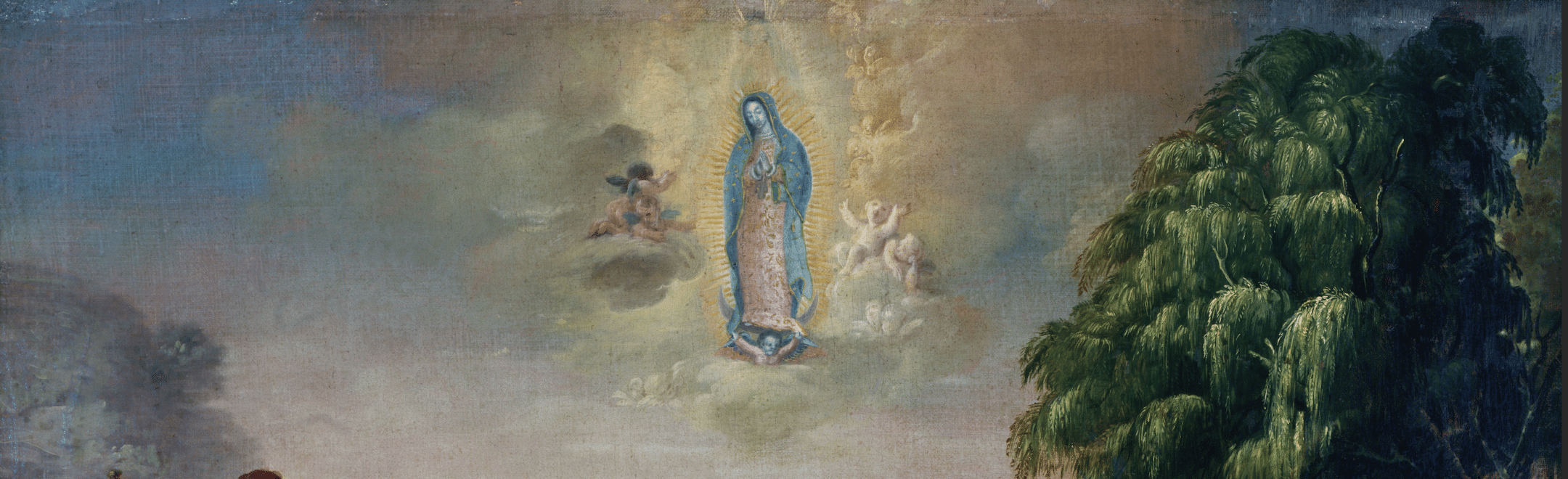
The Wonder of America
a pastoral letter to the family of God in Los Angeles
in preparation for the 500th anniversary of the
apparitions of Our Lady of Guadalupe
Most Reverend José H. Gomez
Archbishop of Los Angeles
September 8, 2026
+Nativity of the Blessed Virgin Mary
Download PDF (color) + (grayscale) | Learn More on Angelus News
Celebrate Our Lady of Guadalupe in Los Angeles
“I call this work the wonder of America.”
— Don Miguel Cabrera
American Wonder, and a Collection of Rare Wonders, Observed According to the Rules of the Art of Painting in the Wondrous Image of Our Lady of Guadalupe of Mexico (1756)
Chapter 1/Behold your Mother
My favorite time to visit the Basilica of Our Lady of Guadalupe is at the end of an ordinary work day. The pilgrims have departed and the local faithful have gone home for supper. It is quiet and still, the sun is setting, and the natural light inside the sanctuary grows softer.
In this twilight time, before they close the doors for the evening, I like to sit up front and place myself before the image that sits high on the wall behind the altar. I look up at Our Lady and she looks down on me.
There is a youthful sweetness to her face. The natives who first saw this image called her La Morenita, the dark-skinned girl. I am drawn to her dark eyes. She looks at me with a mother’s tenderness.
When I was a child, many summers my mother and father would take my sisters and me on a pilgrimage to this place. We would stay with my grandparents and we would all go up to the shrine together. It was a 600-mile car ride from Monterrey, where I grew up, to this place in Mexico City.
Like their parents before them, my parents wanted their children to know and love Jesus and His mother.
They also wanted us to know the story of Our Lady’s apparition here: those three days in December 1531 when she appeared to a native convert named Juan Diego on Tepeyac Hill and gave him a message to deliver to his bishop. How she left this miraculous image of herself, a self-portrait she “painted” with her own hands on Juan Diego’s cloak, using exotic flowers that never bloom at that time of year. How, nearly 500 years later, this image she gave us still hangs behind the altar in this place.
The story of Guadalupe has been with me for as long as I can remember, and somehow I always felt that I was part of it. Our Lady’s words to Juan Diego made a claim on my life, too: “Listen my son … where are you going?” I understood that I had a purpose in God’s plans, like Juan Diego. There was some duty I was born for, and Our Lady would help me discover it and carry it out.
All these years later, I realize that Our Lady of Guadalupe has gone with me every step of the way on my journey, guiding me, drawing me closer to her Son.
To Jesus through Mary
I grew up loving Our Lady of Guadalupe. There was nothing forced about it, devotion to her came naturally. I suppose I learned from watching my parents. It was not something we talked about a lot. It was just how we lived.
Our neighbors lived the same way. We all had the image of Our Lady of Guadalupe in our homes, and when we went out, she seemed to go with us. The shopkeepers had Our Lady on their walls and in their windows. Her image was on people’s desks in their offices. The bus driver and cabdriver had her image hanging from their rearview mirrors.
I remember my father, along with the other men in town, would make a pilgrimage to the local shrine in Monterrey for her feast day, Dec. 12. Company by company, factory by factory, they would walk in long processions to show their love for Our Lady.
Years later, when I started studying the Gospels, I learned that Jesus wanted all of us to know Mary as our mother and love her as He loves her.
Mary was Jesus’ final gift to us and devotion to her was His last command. Looking down from the cross, He said: “Woman, behold your son.” Then, turning to His beloved disciple standing next to her: “Behold your mother.”
The Gospel tells us that from that hour St. John took Our Lady into his home. The saints teach us that we are also beloved disciples, and that we, too, must take Mary into our homes and into our hearts, to behold her as our mother.
Jesus intended His mother to be our way to Him. To Jesus through Mary. This is the hard-won wisdom of the saints. I grew up knowing that. Not as teaching or doctrine. It was just how we lived.
 All generations shall call me blessed
Mary is the mystery at the heart of the life of Christ. She herself had predicted that “all generations shall call me blessed.” And in every generation, artists have sought to capture something of the beauty of this mysterious woman whom God chose to be the mother of His only Son.
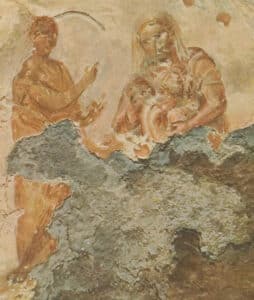
The first painting of her that we have comes from the Catacombs of Priscilla in Rome. That fresco, thought to be painted in the 230s, shows Mary seated with the infant Jesus on her lap. Standing slightly behind her is a man, maybe the prophet Isaiah or the seer Balaam, pointing to a star in the sky above.
The same catacomb holds what might be the first sculpture of Mary, carved on the tomb of a woman called Severa. It depicts the Gospel scene of the Magi bringing their gifts to the newborn king of the Jews. Mary sits on a high chair, again holding the Infant in her arms.
The life of Mary has inspired some of the greatest art ever created, and these works have come to define how we “see” her and think about her. In the continent of Europe, we think of Murillo’s “Immaculate Conception,” Blessed Fra Angelico’s “Annunciation,” Michelangelo’s “Pietà.” We think of Titian’s “Assumption,” Raphael’s “Sistine Madonna,” Caravaggio’s “Madonna of Loreto.”
In the Americas, we think of the striking Madonnas from the Cuzco School in Peru and the great Marian art of the New Spain painters, figures like Miguel Cabrera and José de Ibarra. My favorite may be Cristóbal de Villalpando, whose transcendent “Woman of the Apocalypse” hangs in the sacristy of the cathedral in Mexico City. In the United States, we think of Henry Ossawa Tanner’s “Annunciation” and the “Pietà” of Ivan Meštrović that is in the basilica at the University of Notre Dame.
Tradition tells us that St. Luke was the first to paint our Blessed Mother’s image. There are dozens of paintings and sculptures claiming to be the work of St. Luke’s hand, scattered in churches and shrines all over the world.
Beholding Mary, our greatest artists have produced some of the greatest art in the history of Western civilization. But in my opinion, none compares to Our Lady of Guadalupe. The image “painted” on Juan Diego’s cloak, called a tilma, is the most beautiful to me. It remains the only picture of Mary not created by human hands.
The tilma is made from a rough, perishable cloth woven from agave fibers. By all accounts, it should have deteriorated a long time ago, especially in the salty air that comes from the lake in Mexico City near where it hangs. But the tilma has been studied by artists and scientists from many disciplines over many years. No one can yet explain how the image was created on the cloth or how the tilma itself has survived.
The Church approaches accounts of apparitions with both openness and discernment, inviting us to contemplate such mysteries without requiring us to accept them as miracles. Catholics are free to believe that the image on the tilma is miraculous, just as we are free to believe that the Blessed Mother appeared to Juan Diego in this place in 1531. But neither belief is an article of faith.
Through the centuries, the Church has recognized and encouraged devotions associated with Our Lady of Guadalupe and a number of other Marian apparitions. Among the best known are those associated with St. Catherine Labouré in Paris in 1830, St. Bernadette Soubirous in Lourdes, France, in 1858, the children at Fátima, Portugal, in 1917, and the apparitions to the Servant of God Adele Brise in Champion, Wisconsin, in 1859 — the only approved Marian apparition in the United States.
The Catechism of the Catholic Church calls apparitions like these “private revelations.” These apparitions add nothing to what God has revealed to us in Jesus Christ. Rather, the Church teaches that they may help us to live the Gospel “more fully” in a “certain period of history.”
I believe the Guadalupe apparitions happened, that they were a true historical event. When I behold my mother, when I think of her love for me, I see Our Lady of Guadalupe. I see her face. In the gaze of her tender eyes, I know myself to be a child of God. I know she is my mother.
The fullness of time
As the 495th anniversary of her apparition draws near, my thoughts return to God’s mysterious plan of salvation — how, when the fullness of time had come, He sent His only Son into our world to be born of a woman.
Jesus came to save us from sin and death and to show us God’s beautiful plan for our lives. He was sent to be the firstborn of many brothers and sisters, the perfect image of the child of God that we are all called to become through faith in Him. In the Catechism’s words: “The vocation of humanity is to show forth the image of God and to be transformed into the image of the Father’s only Son.”
Jesus commanded His Church to preach this Good News to all creation and to gather men and women from every nation, race, tribe, and culture into one family, the Church, where we are meant to live in love as brothers and sisters and sons and daughters of the God whom Jesus taught us to call our Father.
Beginning from Jerusalem, in the upper room where Mary and the apostles prayed for the Spirit to come at Pentecost, the Church went forth, spreading the Gospel across the Roman Empire and throughout the nations of Europe, Africa, and Asia.
In the early 16th century, with the apparitions of Our Lady of Guadalupe, the Church’s mission reached the Americas. Within a few decades of these apparitions, missionaries were going out from Mexico. They evangelized Latin America and North America, and also the Caribbean, the Philippines, and countries in Asia and Oceania.
You and I are Guadalupanos, the spiritual children of Guadalupe. This is true for everyone born in the Americas. We owe our Christian faith to that first generation of missionaries who followed Our Lady’s apparitions. The Church in Los Angeles and the Catholic Church in the United States are born from that mission. We all live in the new world that Holy Mary of Guadalupe came to bring. The New World of Faith.
I consider the Guadalupe event to be one of the great turning points in the history of the West. It is the true origin story for the United States and the nations of the Americas. Guadalupe holds the key to understanding God’s original intentions for these continents. Five hundred years later, it also holds the key for discerning the Church’s continued mission here.
Missions, my Lord, that is what this country needs
I am writing this pastoral letter to you because I believe that these next five years, as the 500th anniversary of Our Lady’s apparitions draws near, will be a time of many graces and spiritual opportunities. With this letter I hope to prepare us to receive the Lord’s gifts during this Guadalupe Jubilee, to deepen our appreciation for the miracle that is Guadalupe, and to realize what this miracle means for our lives, for our vocation as disciples, and for the Church’s ongoing mission.
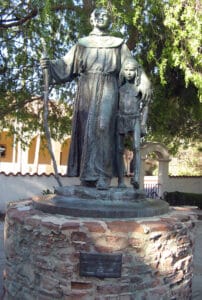
In Los Angeles, we trace our spiritual roots to these apparitions, through the heroic Franciscan missionary St. Junípero Serra, who founded our Mission San Gabriel Arcángel in 1771 and our Mission Basilica San Buenaventura in 1782, planting the seeds of the Christian faith in southern California.
Junípero placed all of his apostolic labors under the patronage of Our Lady of Guadalupe.
In 1749, at the age of 35, Junípero left his native Mallorca to become a missionary in the New World. A few months later, he embarked from Cádiz for New Spain aboard a ship named Nuestra Señora de Guadalupe. He arrived 100 days later at Veracruz, and immediately set out on foot to make the 300-mile journey to Our Lady’s shrine in Mexico City. He spent the night in prayer there, and in the morning offered the Eucharist, consecrating himself and his continental mission to the Virgin of Tepeyac.
The image of Our Lady of Guadalupe would be displayed prominently in all 21 missions established in California, so that all who entered would know they are loved by the mother of the true and living God.
We rejoiced when Pope Francis canonized Fray Junípero in 2015, making him America’s first Hispanic saint and the first American saint canonized on American soil. I was honored to concelebrate that canonization Mass with the Pope in Washington, D.C.
Francis believed that St. Junípero should be regarded as “one of the founding fathers of the United States.” I agree.
Long before this country had a constitution, St. Junípero and the generations of missionaries before him were teaching and dying for the truths that America’s founders held to be self-evident — that this is one nation, under God, and that every man and woman is created equal, with God-given rights to life and freedom.
In God’s providence, the Church’s memorial for St. Junípero is July 1, three days before our nation celebrates its Declaration of Independence on July 4. I think it would be beautiful if one day Catholics and all Americans celebrated these events together, remembering that St. Junípero and the missionaries are also true founders of this great nation, and that America’s identity and purpose can only be fully understood in light of God’s plan for salvation history.
St. Junípero dreamed of creating what he called “a ladder of missions” along the western edge of this great American continent. In one of his letters, he declared: “Missions, my Lord, missions — that is what this country needs.”
This is still what this country needs: a new mission to proclaim Jesus to the people of our time. A new mission that we place at the feet of Our Lady of Guadalupe.
 Here is told
With this pastoral letter I hope to offer my own humble contribution to our thinking about this new mission to America.
I have been reading the Nican Mopohua (“Here is told”), the account of Our Lady of Guadalupe’s apparitions, for at least half a century. I have come to regard these apparitions as an American revelation, and the Nican Mopohua as an American scripture — not divinely inspired the way the Bible is, but divinely given, and a gift that continues to open its treasures for us, 500 years on.
This text dates to sometime before Juan Diego’s death in 1548 and is based on his testimony, that of his uncle, who also saw and spoke to the Virgin, and that of the bishop who received the miraculous image. These oral traditions were written down in the Náhuatl language by Antonio Valeriano, an indigenous scholar who worked with the pioneering missionary and historian Friar Bernardino de Sahagún. The oldest surviving copy of the text can actually be found in this country, in the collections of the New York Public Library.
The Nican Mopohua is a tale of adventure, the story of a man who receives a vision and sets out on a quest. We can read it almost like a medieval tale of knights and chivalry, as Juan Diego carries out the mission entrusted to him by Our Lady. But it is also the original primary text of American Catholicism — a Christian work that is wonderfully “inculturated,” written in the language of America’s first peoples and reflecting their traditions, customs, and beliefs.
Its pages are filled with poetry and rich sources for theological and spiritual reflection — on Mary and Jesus, on the Church and her mission, on her bishops and priests. The text speaks of the mystery and vocation of the human person, the glories of creation, and God’s dominion over the nations; it tells of the importance of the family; it speaks of suffering and death and heaven.
I hope my letter can encourage new study of the “Nican Mopohua.” It is among the earliest accounts of God’s dealings with the peoples of the Americas. To my mind, it should inspire our work of evangelization and our search for a uniquely American theology and understanding of the faith, rooted in the encounter of the Old and New Worlds that we find in the “Nican Mopohua.”
In the pages that follow, I want to simply read the Nican Mopohua with you. We will begin by looking at the historical context for Our Lady’s apparitions, the conflicted and complicated history of the Church’s mission to the New World. We will turn to the figure of Juan Diego and the drama of his vocation and the mission that he was entrusted with by Our Lady. We will then look closely at the mystery of the sacred image that Our Lady left on his tilma, which I consider to be an American icon. Finally, I want to suggest what the text might mean for our lives and vocations and the Church’s mission, 500 years on.
My intention is to read the Nican Mopohua both historically and spiritually. As an American scripture. And I cannot write about Our Lady of Guadalupe without writing personally, from the heart, and from all my memories of all her kindnesses to me. My hope is that you will read these pages personally as well, thinking about Our Lady’s loving kindness in your own life. Read this as a series of short reflections, in a spirit of prayer. I pray that Our Lady will stir your heart as you read, and renew your zeal to continue her mission of bringing Jesus to the New World.
Chapter 2 /The Marian heart of America
On that December morning when Juan Diego met Our Lady at the top of Tepeyac Hill, her clothes shone like the sun, waves of light seemed to vibrate around her.
“The earth seemed to shine with the brilliance of a rainbow in the mist,” we read in the Nican Mopohua. The sun was coming up and all of creation seemed to be coming alive; the songs of rare birds filled the air; the stones and crags of the hill gleamed like precious jewels, like jade; the mesquite and cactus glowed brilliant green, like the feathers of the quetzal bird, their trunks and thorns shone like gold; the surrounding plants were all colored turquoise.
Mary enters Mexico bringing a new Eden. She comes as the Mother of the New World, to announce the birth of Jesus in the newly discovered lands of the Americas.
“Know, know for sure,” she tells Juan Diego in that first meeting, “that I am truly the perfect Holy Virgin Mary, who has the honor to be the Mother of the one true God for whom we all live, the Creator of people, the Lord of all around us and of what is close to us, the Lord of Heaven, the Lord of Earth.”
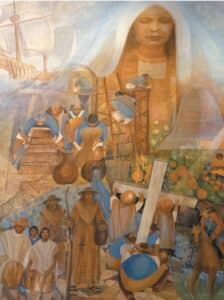 She comes not only to the Mexican people, but to all the peoples of the Americas and the world: “Truly I am honored to be your compassionate mother, yours and that of all the people that live together in this land, and also of all the other various lineages of men,” she says.
The apparition at Guadalupe occurred just 49 years after Christopher Columbus planted the cross of Jesus Christ on the island of Santo Domingo, opening the door of faith for the Gospel to reach the lands and peoples of the Americas.
It was an age of exploration and there was great missionary enthusiasm in Europe. The discoveries of Columbus and others excited the popular imagination. People were fascinated by the descriptions of this new continent and its inhabitants that were being sent back by explorers and missionaries.
Columbus was a man of faith who believed that God was guiding his voyages, using him as “a messenger of the new heaven and the new earth.” Through his discoveries, he believed God was preparing the way for the Church to be able to reach the last peoples on earth who had not yet heard the Gospel.
Columbus was not alone in seeing these lands as the final frontier of the Church’s universal saving mission. There was a utopian, millennial mood in European Catholic circles in the 16th century, influenced by the writings of the Franciscan mystic Joachim of Fiore, who had foretold the coming of a final Age of the Holy Spirit.
Many in the Church were convinced that these new lands — from the top of what is now Canada to the tip of what is now Argentina — were the mundus novus, the “new world” that Jesus promised would come at the close of the age. The first missionaries to the Americas — Dominicans, Franciscans, Jesuits, Augustinians, and Mercedarians — all believed that after these lands were evangelized, Jesus would return to reign forever over heaven and earth.
There was a great outpouring of mystical fervor surrounding the Americas. A Franciscan mystic from Spain, Venerable María de Ágreda, reported being transported in the spirit more than 500 times to what is now New Mexico, Arizona, and West Texas. Natives in those regions later testified to missionaries that they’d been visited by a “lady in blue” who taught them about Jesus. They said she spoke in Spanish but they understood in their native tongue.
St. Teresa of Ávila and her Carmelite sisters took a passionate interest in the missionary project. St. Teresa wept for the “many millions of souls that were being lost [in the Americas] for want of Christian instruction.” She added: “I was very envious of those who for the love of our Lord were able to be engaged in winning souls.”
In 1524, seven years before Our Lady’s apparitions, the Franciscan minister-general, Friar Francisco de los Angeles, sent 12 apostles to Mexico. He instructed them that they would be the last to preach the Gospel before the end-time: “The day of the world is already reaching the eleventh hour,” he told them.
All nations in the plan of salvation
To enter into the mystery of the Guadalupe event is to enter into the history of America’s first peoples and into the deeper mystery of God’s plan of salvation, the plan of the mystery for all humanity, hidden for all ages, as St. Paul called it.
In our secular age, even many of us in the Church now tend to think that history is only a human affair, that the events of our lives and the circumstances in the world have only material causes: political, economic, social, or cultural.
But Jesus Christ remains the Lord of history. God the Father in His providence continues to carry out His plans through the workings of the Holy Spirit. The mission that Jesus entrusted to the Church was a mission ad gentes, to all the nations, and it continues to the end of the age, when He returns.
The Guadalupe event reminds us that the Americas were born from the Christian mission, which was born from the heart of Jesus and His original command to the Church: to go into the world and proclaim the Gospel to every creature and make disciples in every nation to the ends of the earth.
In his last book, St. Pope John Paul II wrote: “The history of all nations is called to take its place in the history of salvation.”
John Paul taught us the importance of recovering the truth that all of human history is salvation history, that the God who created us is still working in creation; that our lives, and the life of nations, continue to unfold according to His loving purposes.
I believe it is crucial for us to recover this divine-historical awareness in the Church today. It is not easy, especially in our times, which are dominated by secular thinking and a scientific outlook that leaves no room for God. But we need this divine perspective, rooted in faith. Our mission depends on it. Jesus calls us to “interpret the signs of the times” — to see reality and history in light of the Gospel and God’s plan.
John Paul was the first Pope to make a pilgrimage to the shrine of Our Lady of Guadalupe; in fact, he made it a point to celebrate the Eucharist there as part of his first apostolic pilgrimage outside Rome. He said he wanted to begin his pilgrim journeys by placing himself “at the feet of Our Lady of Guadalupe.”
His own spirituality was shaped by his devotion to the miraculous image of the Black Madonna of Czestochowa in his Polish homeland, and the Pope understood on a personal level the great love that the Mexican people feel for Our Lady.
I was a young priest, working on my doctorate in theology in Spain, when he made his visit to Mexico on Jan. 27, 1979. I still remember the images of that day that went worldwide.
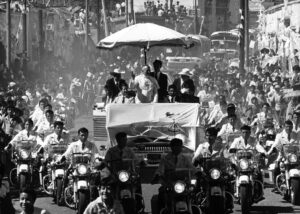 Millions lined the streets along the way to the basilica, families and young children, many weeping with joy, as the Pope drove by slowly, standing in the front of an open white car, smiling and blessing everyone as he went. He would later write that that first day at Tepeyac in 1979 “inspired and shaped all the succeeding years of my pontificate.”
John Paul called the basilica at Tepeyac “the Marian heart of America,” and spoke often of the need for a “new evangelization on American soil.” He was also the first Pope to reckon with the enormous sufferings of the indigenous peoples caused during the original mission in the New World.
“It is necessary to acknowledge in all sincerity the abuses committed due to the lack of love on the part of those persons who were unable to see the natives as their brothers and sisters, as children of the same Father,” he said in a message to the Indians of Santo Domingo, on the 500th anniversary of Columbus’ arrival.
On many occasions in the United States, Canada, and Latin America, John Paul apologized on behalf of the Church for the “sinfulness of her children,” asking pardon and forgiveness from the ancestors of these noble peoples, and urging a new beginning, “to learn from the mistakes of the past and … work together for reconciliation and healing, as brothers and sisters in Christ.”
Are they not human beings?
I had the honor to be appointed a bishop and then an archbishop by Pope John Paul II. His love for Mary, and his teachings about history, holiness, and evangelization continue to influence my ministry. And I believe all of us in the Church need to keep learning from the Holy Father’s love for our indigenous brothers and sisters, and his sensitivity to the healing of memories and the search for historical reconciliation.
John Paul’s vision of history as salvation history helps us as we seek to interpret the meaning of the Mother of God’s coming to Tepeyac in 1531. We can sense the tensions in the very first lines of the Nican Mopohua:
“Ten years after the conquest of the water, mountain, and city of Mexico, when the arrows and shields were put aside, when there was peace in all their towns, their waters and their mountains. Just as it budded, faith now grows green, now opens its corolla, the knowledge of the Giver of life, the true God.”
These lines capture the cruel contradictions and mixed motives of that first encounter between the Spanish and the peoples of the New World, the struggle between “conquest” and “faith.” Between the earthly ambitions of the Spanish colonialists, who came seeking silver and gold and power and glory, and the missionaries who came to proclaim the love and salvation of Jesus.
It is well known and widely documented that the Spanish conquest was a disaster for the first peoples of Mexico, Hispaniola, and elsewhere in the continent. Though these tribes were unknown to the Europeans, they were long known to God. They were proud peoples whose histories went back thousands of years, with their own languages, cultures, and religious imaginations and traditions.
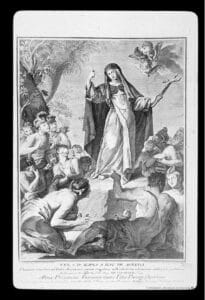 Motivated by greed, by the false legend of El Dorado, the Spanish enslaved these peoples, treating them like animals, beasts of burden; the Spanish tore families apart, committed unspeakable crimes against their women, mercilessly destroying their ways of life.
From the beginnings of their work in the Americas, the missionaries condemned the colonizers’ abuses and defended the natives’ dignity and humanity. In a homily delivered on the Sunday before Christmas in Santo Domingo in 1511, the Dominican friar Antonio de Montesinos challenged the consciences of the colony’s leaders with a series of burning questions. These words are quoted often in histories of the Americas, but they are worth reading closely to appreciate the gravity of the colonial abuses and the prophetic nature of the missionaries’ faith:
“Tell me by what right or justice do you hold these Indians in such cruel and horrible servitude? On what authority have you waged such detestable wars against these people who dwelt quietly and peacefully on their own lands? … Why do you keep them so oppressed and exhausted, without giving them enough to eat or curing them of the illnesses they incur from the excessive labor you give them? And they die, or rather, you kill them in order to extract and acquire gold every day? And what care do you take that they should be instructed in religion, so that they may know their God and creator, may be baptized, may hear Mass, and keep Sundays and feast days? Are they not human beings? Do they not have rational souls? Don’t you understand this? Are you not bound to love them as you love yourselves?”
Love compelled the first missionaries to this continent. Only love can explain their commitment and the sacrifices they made. They believed with all their hearts that the Gospel was true and that Jesus Christ was the salvation of every soul. For the love of Jesus and the love of souls, they gave up everything, journeying to the other side of the world, knowing they might never see their families again. They came with one motive: to bring Jesus to a people who had never heard His name, a people they did not even know.
These first missionaries learned local languages and cultural ways; they lived and worked and ministered close to the people; they sought ways to explain and “inculturate” the Gospel through music, dance, drama, and art. They introduced native peoples to agriculture, industry, and education. They endured hardships, were attacked and reviled, and sometimes tortured and killed. All for the love of Jesus and for the sake of His Gospel.
We cannot fairly judge the actions of the past by the values and assumptions of the present, and it is true that the missionaries made mistakes; there were tragic misunderstandings, cultural blind spots, unfortunate attitudes. But those failures do not define the first evangelization of the Americas, nor do they tell us what was deepest and most enduring in that history. Far from it. God’s love is stronger than sin, and where sin increases, grace abounds the more.
Through their preaching and personal witness, these missionaries planted the seeds of the Gospel and helped the kingdom of God to grow and flourish throughout the Americas. In Mexico, people who for centuries offered human sacrifices to their gods came to know the true and living God, who is the God of love and life and peace.
Today we should celebrate these first missionaries for their holiness and heroism, and their courage and creativity in the service of the Gospel. We should study their methods and learn from their example as we seek to spread the Gospel in the often hostile culture of our time and place.
The missionaries’ defense of indigenous peoples helped lay the foundations for modern international law and our belief in universal human rights. We should be studying this history in our Catholic schools and colleges. Sadly, the missionary period remains a largely unknown — and too often distorted — chapter in the history of Catholic social doctrine.
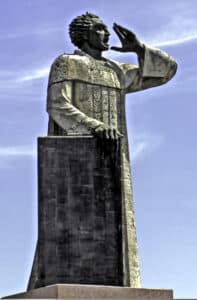
But I pray that this 500th anniversary will mark a new beginning and will renew our desire to return to the sources and learn from the witnesses of that first generation: Dominicans such as Pedro de Córdoba, Antonio de Montesinos, and Bartolomé de Las Casas; bishops such as Vasco de Quiroga and St. Turibius of Mogrovejo; pioneering evangelizers such as Ramón Pané; and the Franciscans, Luis de Fuensalida and Pedro de Gante.
 On the verge of being lost forever
Among the long line of heroes of the first evangelization we must include Bishop Juan de Zumárraga, the Franciscan bishop who was at the center of the Guadalupe drama.
Known for his holiness and love for the poor, Fray Zumárraga was chosen by Emperor Charles V to serve as bishop of Mexico City; the emperor also gave him solemn legal responsibilities as “Protector and Defender of the Indians.”
Fray Zumárraga took those responsibilities seriously. He was a humanist who had studied the philosophies of St. Thomas More and Erasmus of Rotterdam. He believed passionately in the inherent dignity of the native peoples as children of God.
What he found in Mexico were the worst possible conditions. Historians describe it as a reign of terror enforced by a notorious and brutal local authority known as the Audiencia. Natives were enslaved to work for the Spanish nobles under threat of death; missionaries who opposed them were abused in their churches; some were tortured in hideous ways.
Fray Zumárraga used all the spiritual means at his disposal to stop these crimes. He led the faithful in processions demanding reforms and the release of native prisoners. He sent out his best preachers to denounce slavery and abuses from their pulpits; he excommunicated the worst offenders. At one point, he put all of Mexico City under an interdict, removing the Eucharist from every tabernacle and forbidding Mass to be celebrated.
Hated by the colonial authorities, he survived several assassination attempts, including a notorious spear attack by a Spanish judge.
Despite the violence, the bishop tried to carry out a positive social program, establishing schools for native boys and girls, starting a college and hospitals; he brought in a printing press and commissioned and published books for the indigenous.
The oppression only continued. Over time the scandal of the Spaniards’ “counter-witness” made it impossible for the missionaries to attract new converts. The natives wanted nothing to do with the religion of people who could be so cruel and vicious. Frustrated, many missionaries started talking openly of returning to Spain.
On Aug. 27, 1529, in a desperate moment, Bishop Zumárraga wrote a long letter to Emperor Charles V. After documenting the outrages against the native population, he concluded in words that would prove prophetic:
“I think it well to inform Your Majesty of what is happening now, because it is something so important that if God does not intervene to provide a remedy from His own hand, this land is on the verge of being lost forever.”
Two years later, God would answer this prayer.
In 1531, the land was visited with a series of unusual natural events — earthquakes, a lunar eclipse, a comet in the sky. The traumatized natives believed their world was about to come to an end. Near the end of that year, during the winter solstice, the mother of Jesus appeared to Juan Diego.
She comes as the woman of the Magnificat, comes to proclaim the God whose mercy is from generation to generation; the God who with the strength of His arm scatters the proud in their imaginations of domination, pulls down the mighty from their thrones, and exalts those of low degree. The God who fills the hungry with good things and sends the rich away empty.
Our Lady comes as the advocate for the oppressed, promising to intercede for them: “Truly will I hear their cry, their sadness, in order to remedy, to cure all their various troubles, their miseries, their pains.”
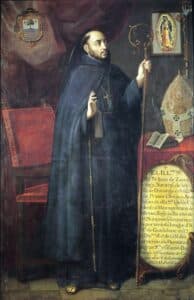 She appears at Tepeyac Hill, where there once stood a temple to the fierce Aztec mother goddess, Coatlicue. One of the few surviving statues of Coatlicue, now in the National Museum of Anthropology in Mexico City, depicts her with a head made from two serpents looking at each other; her hands and feet are claws; she wears a skirt made out of twisting serpents and a necklace strung with human hearts and severed hands; a pendant made of a human skull hangs from her neck.
Mary comes in a stark contrast, as a beautiful and gentle dark-skinned girl, La Morenita. Not as a goddess, but as the mother of the God of life and love, “the Creator of people.” In her image on the tilma, she is a maiden clothed in the sun, standing on the moon, and wearing a mantle of stars and a gown embroidered with various flowers — all signs that by her visitation, through the Child she brings, the peoples’ deepest religious hopes will be fulfilled.
The natives believed that heaven was a paradise that they called the land of the flowers or the “flower world” — a mountain top covered with flowers and filled with the sounds of precious birds singing. They created a great literature as well as songs and dances and paintings, all expressing their belief that one day they would live forever with their Creator and ancestors in this land.
On that first morning, Juan hears the singing of rare birds. The Nican Mopohua says that among the birds he heard were the coyoltototl and tzinitzcan — birds associated with the flower world myths.
Juan wonders if he is dreaming: “Where am I? Where do I find myself? Is it possible that I am in the place our ancient ancestors, our grandparents, told us about: in the land of flowers (Xochitlalpan), in the land of corn, of our flesh, of our sustenance, perhaps in the land of heaven?”
Xochitlalpan is the Náhuatl word for the flower land paradise, and Juan describes birds’ singing as “the precious heavenly song.”
By her coming Mary is bringing the paradise that Juan and his ancestors had longed for. And in a beautiful and gentle image at the end of the story, Our Lady will use the flowers that the native peoples associated with paradise to fashion her own image on the tilma, as a perpetual sign of God’s love for them. In this sacred image, all generations will call upon her — the Mother of the true and living God, the Marian heart of the New World.
Chapter 3/ His name was Juan Diego
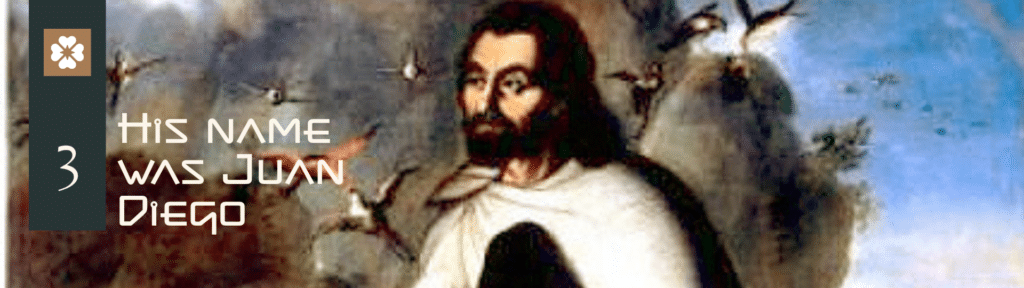
At the heart of the Guadalupe story, at the heart of the mystery that unfolds at Tepeyac, is an ordinary man. “His name was Juan Diego,” the Nican Mopohua tells us.
Our Lady chose to appear, not to the nobles, the colonial authorities, the missionaries, or the priests or the bishop. She came to “an Indian, a macehual, a poor man of the people.” She revealed herself to a recent convert, an indigenous layperson. The Náhuatl word, macehual, indicates that he was a middle-class small landowner. The Mother of God called this humble person to carry out the sacred task of opening the door of faith, of bringing Jesus Christ to these vast new continents.
St. Paul said that God chooses the lowly so that no one may boast before God. And that is true. He chose Juan Diego, and He chooses you and me, each in our own way. In the mystery of His saving plan, Jesus wants to work through each of His children to accomplish His purposes here on earth, to complete the work of redemption. This is an important truth expressed in the story of Juan Diego and Our Lady of Guadalupe.
I said earlier that we can read this as the story of a man who receives a vision and sets out on a quest. We can also read it as a medieval tale of knights and chivalry, as Juan carries out the mission entrusted to him by Our Lady; Juan even uses what seems like chivalric language, addressing Mary as “My Lady,” “My Lady Mistress,” “My Queen.”
But as Catholics, we should read this as a story of personal vocation and mission. Juan Diego is a man who has been called by God. In him, we see the calling that Jesus makes to every soul in baptism, and the vocation that He gives to each of us — to share in His mission, to play our part in spreading the good news of His love and salvation, each of us according to our state in life.
In her first words to Juan, Our Lady evokes his baptism, calling him by name, reminding him that he is a child of God: “Listen, my youngest son, Juanito, where are you going?”
In her words we hear the echoes of the great callings in biblical history — of Abraham, Samuel, and Isaiah, among others. We hear Jesus calling us: Where are we going? What are we doing with our lives? What are we doing for Him, to advance His kingdom?
Go and do what you are responsible for doing!
We know from historical sources that Juan was about 57 years old at the time of the apparitions.
Juan Diego was the name he took in baptism. Born of the Chichimeca peoples, his given name was Cuauhtlatoatzin, which means “eagle that speaks.” Juan was one of the first native converts in Mexico, baptized seven years earlier along with his wife, María Lucía, at the Church of Santiago de Tlatelolco by the Franciscan Toribio de Benavente Motolinía, who was one of the “12 apostles” first sent to Mexico in 1524. You can still visit this church and pray at their baptismal font.
Since his wife’s death, Juan had been living in the town of Tulpetlac with his uncle, Juan Bernardino, also a convert. He was on his way to the Church of Santiago on that Saturday morning for catechesis and prayer. It was a nine-mile walk, and when he reached the top of Tepeyac Hill he saw the beautiful woman with clothes that shone like the sun. “Dear Juan,” she called, “dearest Juan Diego.”
Mary speaks in his native Náhuatl and Juan feels she is “drawing him toward her and loved him.” She says she is the “Holy Virgin Mary” and she has a mission for him to carry out. Juan is to go to the bishop and tell him that the Mother of God wants him to build for her a “sacred little house,” which she also calls “my temple.”
What she wants is a Catholic church built on Tepeyac Hill. What she promises is amazing. In this church, she says, she will give the living God to the peoples of the Americas. The Eucharist is not mentioned in the story, but the language that Our Lady uses is clearly eucharistic and incarnational. In this little church, in the tabernacle, and on the altar, the Mother of the one true God will make God present.
“I will exalt Him upon making Him manifest,” she says. “I will give Him to all people in all my personal love, Him that is my compassionate gaze, Him that is my help, Him that is my salvation.”
The Eucharistic meaning here is deepened by Juan Diego’s reference to the Catholic understanding that the priest, by ordination, is given sacred power to celebrate the Eucharist in persona Christi (“in the person of Christ”). Juan says he is on his way to the “little house in Tlatelolco” to see “our priests, those who are the images of the Lord, Our Lord.”
For the indigenous peoples, temples were the center of civilizations, where the gods were present and received the people’s sacrifices. Building a new temple meant the coming of a new civilization with new gods. That is how the “Nican Mopohua’s” first readers would have understood Mary’s words. She is talking about far more than building a new church.
She is announcing the birth of a new civilization and a new God who will fulfill all that the natives had ever hoped for in their ancient gods. This new God is not another tribal deity, another god among the many native gods. Mary’s God is universal. Our Lady uses the Spanish word for God — Dios — identifying Him as the God who made the world and everything in it, while referring to the native gods by their Náhuatl names:
“I am … the mother of the true God [téotl Dios] by whom we all live [Ipalnemohuani], the Creator of people [Teyocoyani], the Lord of near and far [Tloque Nahuaque], the Lord of heaven and earth [Ilhuicahua Tlaltipaque].”
Juan’s mission is nothing less than to announce that God’s kingdom is coming to the Americas, a new civilization that will embrace in love every person on earth, no matter the color of their skin, or what language they speak, or where they come from.
So, Mary sends him out: “Now, my dearest son, you have heard my breath, my word. Go and do what you are responsible for doing!”
Juan goes immediately. His words remind us of how the apostles responded to Jesus’ call, leaving everything behind at once to follow Him: “I will go and make your venerable breath, your venerable word, a reality; for now, I leave you, I your humble servant.”
 An ecclesial drama
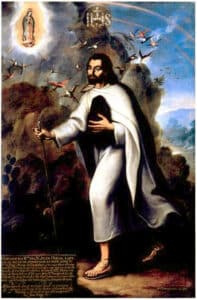
The Nican Mopohua unfolds from here as a sort of ecclesial drama; its narrative follows Juan’s efforts to convince the bishop that his vision is real.
He faces resistance from the bishop’s staff — they rough him up, try to intimidate and humiliate him, they call him a liar and a “lowly Indian.” Bishop Juan de Zumárraga is portrayed as fatherly and kind, but skeptical. Juan twice goes to his offices to plead his case. Following their second meeting, the bishop tells him that he will need “some other sign” before he will believe his tale.
God chose Juan Diego, and He chooses you and me, each in our own way.
After he is rejected the first time, Juan is disheartened and urges Our Lady to send someone else. Maybe a wealthy noble, he suggests, someone who might be taken more seriously by the bishop and his staff. Again we hear biblical echoes: Moses’ reluctance to lead the Hebrew people, Jonah’s resistance to prophesy, Jeremiah’s excuse that he is too young and inadequate.
Mary’s response is beautiful and profound. To my mind, this is one of the great statements of personal vocation that we have in Christian literature. God has chosen Juan, she says, and there is no one else who can do what he has been chosen to do: “Listen, my youngest son: know for sure that I have no lack of servants, of messengers to whom I can give the task of carrying my breath, my word, so that they carry out my will. But it is necessary that you, personally, go and plead, that by your intercession, my wish, my will, become a reality.”
Juan replies with his own beautiful testimony. Though the road may be hard and he will likely be scorned and rejected, Juan is ready: “My Lady, my Queen … let me not anguish you or grieve your face, your heart. Truly with gladness I will go and carry out your venerable breath, your venerable word. I absolutely will not fail to do it, nor does the road trouble me. I will go now, to carry out your will, but maybe I won’t be heard and, if heard, maybe I won’t be believed. But truly, tomorrow afternoon, when the sun goes down, I will come to return to your venerable breath, to your venerable word, what the Governing Priest answers to me.”
A tone of pastoral realism runs throughout the Nican Mopohua. Juan is portrayed with a depth of humanity — he is an ordinary Christian man with family and parish commitments, trying to live his faith in the world, trying to follow God’s will for his life.
There is honesty in this account, too. Juan is not idealized. We hear his doubts and anxieties. He feels he is not worthy, not qualified to do what God is calling him to do. He gets discouraged by his failures, when his work does not bear fruit. We recognize ourselves in Juan: these are the insecurities and disappointments that every disciple deals with.
Juan also has family obligations. He is caring for his elderly uncle who is in failing health. And at the height of this ecclesial drama — when the bishop has twice rejected Juan, and when Our Lady has promised that tomorrow she will finally deliver the sign that the bishop is asking for — a family tragedy strikes.
Juan comes home to find his uncle on death’s door. So, in the early morning hours, when it is still dark, Juan sets out to Tlatelolco to “call one of the priests to come and hear his [Juan Bernardino’s] confession, to get him ready, because … it was truly now time, that now he would die.”
The scene is heartbreaking, and we feel Juan’s grief and anxiety. Time is running out. He desperately needs to find a priest for his dying uncle, yet he knows that the Queen of Heaven is waiting for him to deliver her sign. Here, too, we can see ourselves in Juan. Faith in Jesus, seeking the holiness that He calls us to, requires a daily decision, and often it is a struggle. The Catechism speaks of the “battle of faith.”
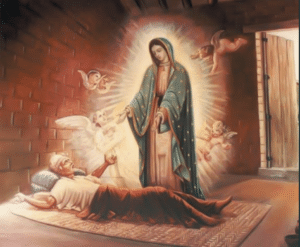 Juan is struggling and he tries to avoid Our Lady. But she confronts him, blocking his path. With tenderness, she tells him that his uncle will not die, that even now he has already been healed. Mary’s words of assurance are the most memorable lines in the Nican Mopohua, and some of the most moving lines in all of Marian literature: “Listen, put it into your heart, my youngest son, that what frightened you, what afflicted you, is nothing; do not let it disturb your face, your heart; do not fear this sickness or any other sickness, not any sharp or hurtful thing.
“Am I not here, I who have the honor to be your mother? Are you not in my shadow and under my protection? Am I not the source of your joy? Are you not in the hollow of my mantle, in the crossing of my arms? Do you need anything more?”
He has not created me for naught
Over the course of those three days of visions, Our Lady of Guadalupe helps Juan Diego discover that he is loved by God, that his life matters to God, and that he has a place and a purpose in God’s plan for the world.
Five hundred years on, this is an enduring lesson. We need to allow Our Lady’s words to Juan Diego to speak to us, to open our hearts and help us recover our own baptismal vocation and mission: “I have no lack of servants … But it is necessary that you, personally, go … that by your intercession, my wish, my will, become a reality.”
Our Lady’s words have always reminded me of the profound meditation by the Doctor of the Church St. John Henry Newman: “We are created to do His will. I am created to do something or to be something for which no one else is created. … God knows me and calls me by my name. God has created me to do Him some definite service; He has committed some work to me which He has not committed to another. I have my mission — I never may know it in this life, but I shall be told it in the next. Somehow I am necessary for His purposes, as necessary in my place as an Archangel in his … I have a part in this great work; I am a link in a chain, a bond of connection between persons. He has not created me for naught.”
I have long felt that these words should be on a prayer card that is given to every Catholic upon their baptism. This is the truth that Our Lady helps Juan Diego discover, and that she helps us to discover. God did not create any of us for “no reason.” Our lives are not casual or random. Each of us is loved; each of us is here because God wants us to be here; and each of us has a part to play in His divine plan. God wants you to do something beautiful with your life, something that only you can do. This is true for me, too, and for every person.
We need to teach this beautiful truth to our young people, especially. We need to help them see that their lives are part of something far greater than themselves, that following Jesus is a great adventure, walking in His footsteps, trying to become more like Him every day, and sharing in His great plan of love.
All of us need to impress this truth upon our hearts: we are children of God and we each have a vocation. Our Catholic faith is not simply an inheritance to be preserved; it is a mission we are called to carry out.
Mary’s last words recorded in the Scriptures come from the wedding at Cana, when she says to the servants: “Do whatever He tells you.”
And what Jesus tells us in every generation is that we must take up our cross and follow Him. We are “God’s fellow workers,” called to sanctify this world — to infuse our homes and neighborhoods, our politics and economics, our cultural and social institutions, with the spirit of the Gospel.
Our mission is the same as the one entrusted to Juan Diego 500 years ago. Again, we recall Our Lady’s words: “I will exalt Him upon making Him manifest, I will give Him to all people in all my personal love … Him that is my help, Him that is my salvation. … And to bring about what my compassionate and merciful gaze would achieve, go.”
This is the first great description of the Church’s mission on the American continent. And it comes from the mother of Jesus who, by her fiat, her “yes” to the call of God — “Let it be to me according to your word” — made the Christian mission possible, bringing Jesus into the world.
Now she calls us to bring Jesus into the world, just as she called Juan Diego. She calls each of us to carry her message, to reveal God to the people of our land, to exalt Him and make Him manifest in everything that we say and do.
As American disciples, we should draw deeply from the witness of Juan Diego, the first indigenous saint of the Americas. We should read the story of Guadalupe as the story of how saints are made.
In St. Juan Diego, we see what it means to live, not according to our own desires and priorities, but according to God’s will. With his whole life, St. Juan Diego says: “Here I am, my Lord, I come to do your will. Not my will, but thine, be done.” As he tells Our Lady: “Nothing will stop me, nor will I find the road too hard. I shall go to carry out your will.”
St. Juan Diego’s obedience helped change the course of history. By living out our vocation and mission with the same faith and courage, each of us can help change the world again. Our Lady of Guadalupe speaks now to each of us, as she spoke to him: “Go and do what you are responsible for doing!”
Chapter 4/The Mother of Jesus was there
There is a simple sentence in the Gospel account of the marriage at Cana. It reads: “And the mother of Jesus was there.” For me, this is a powerful truth: the mother of Jesus was there. Not only at Cana, but from the beginning. Salvation history unfolds through her.
She was there at Nazareth when He was conceived by the power of the Spirit and in Bethlehem where she laid Him in a manger because there was no place for them in the inn.
She was there to present Him as an infant in the Temple, and there when she and Joseph were forced to flee with Him into Egypt to escape Herod’s murderous men. When He was 12 years old, she was there in Jerusalem, to find Him after three days, teaching in His Father’s house.
Mary taught and helped Jesus to grow from a child to a man during the long, hidden years at Nazareth. He was known in His native land as Mary’s boy, and the son of the carpenter.
 The mother of Jesus was there as He began His public ministry. She was the one who asked Him to perform His first miracle, changing the water into wine at the wedding.
She came to seek Him as He taught the crowds, and heard Him hold her up as a model: “Blessed rather are those who hear the Word of God and keep it!” She was there at the foot of the cross to hear His final words, entrusting her to His beloved disciple.
And Mary was there at the birth of the Church, praying with the apostles in the upper room for the Spirit to come down at Pentecost.
St. John Paul II once said: “Where she is, her Son cannot fail to be.” This will always be true. Mary still brings her Son into the world. In every age. In every place. Like her Son, Mary is the same yesterday, today, and forever.
Her first apparition was said to have occurred just seven years after the crucifixion, in the year 40. Mary was still alive in Jerusalem when she appeared to the apostle James who was proclaiming the Gospel in Spain.
James was lonely and discouraged, feeling like his mission was failing. Our Lady came to him while he was praying by the banks of the Ebro River in Zaragoza. According to the legend, she came with angels bearing a pillar made of jasper and a statue of herself and instructed James to build a church to her name. Our Lady of the Pillar, now a basilica, is said to be the first church dedicated to Mary.
At Tepeyac, things were more complicated. Before the bishop would build the church that she wanted, Mary first had to provide him with a supernatural “sign.” So, she instructed Juan Diego to go back up the hill where they had first met three days earlier. He was to cut flowers he would find growing there, gather them up, and bring them to her.
There was no reason for Juan to think that he would find any flowers. It was the dead of winter, when “the ice eats everything up and destroys it,” as the Nican Mopohua describes. Nothing ever grew on that hilltop anyway except small grasses. It was all rocks and burs, thorny plants, mesquite, and prickly pear.
Yet Juan was astounded to see: all around him flowers in bloom of every kind, lovely and beautiful, giving off a “soft fragrance, like precious pearls, as if filled with the night’s dew.” We are told several times that these flowers were like the roses of Castile, in Spain, “the finest that there are.”
He cuts the flowers, brings them to Our Lady, and the Nican Mopohua tells us simply: “She took them in her venerable hands, then she put them back in the hollow of Juan Diego’s tilma.”
Juan then sets out to bring them to the bishop. His heart is light. “It was going to come out fine,” he says to himself, “the flowers would see to that.” Along the way he enjoys their smell and is careful that none fall from his cloak.
Before he can show the bishop, he is forced to suffer some final indignities at the hands of the bishop’s staff. They make him wait for “a long, long time” before announcing him. They crowd around him, menacing, demanding to know what he has in his tilma. “He gave them a little peek,” and they started grabbing, trying to pull the flowers out. But “when they tried, they couldn’t see them anymore, instead they looked painted or embroidered or sewn into the tilma.”
Juan finally meets the bishop, and explains what Our Lady had told him to do. On his knees, he says, “Here they are; please receive them.” He opens his tilma, the flowers tumble to the floor. The mother of Jesus was there.
Everyone drops to their knees in awe. The bishop is weeping, begging forgiveness for his unbelief. “Then and there his tilma became the sign, there suddenly appeared the Beloved Image of the Perfect Virgin Holy Mary, Mother of God,” the Nican Mopohua says.
 Beautiful as the moon, radiant as the sun
The mother of Jesus was there. And she is still there.
From the moment the flowers fall from Juan’s tilma, Our Lady is not seen or heard from again in the Nican Mopohua. But she is there. It is as if she herself has become one with the sign, her image on the tilma has now become a perpetual apparition.
Work began almost immediately to build her sacred little house on Tepeyac Hill. First, Juan’s uncle gave his testimony to the bishop: how the heavenly maiden had come and healed him, how she instructed him that her image should be called: “The Perfect Virgin, Holy Mary of Guadalupe.”
Guadalupe is one of the few non-Náhuatl words in the text of the Nican Mopohua. The name is Spanish, maybe originally Arabic; some say it means “river of black gravel.” The Guadalupe River runs through the town of Extremadura, in Spain. According to tradition, around the end of the 13th century, a mysterious statue of the Black Madonna was discovered near the banks of that river. It became a revered icon, and a monastery was eventually built there to house it.
Our Lady of Guadalupe in Extremadura, now a basilica, became a pilgrimage destination. Columbus went there to pray before and after his voyages. Queen Isabella also went to pray there, as did the conqueror, Hernán Cortés.
No one knows why Mary chose this name for her image. It is part of the mystery. Perhaps it is another Hispanic connection, like the reference to the flowers of Castile, intended to bind the Old and New Worlds more closely together, a further planting of the deep roots of Spanish Catholicism, with its poetry and mysticism, its great art and great saints, in the soil of these new lands. But nobody can say for sure.
The Nican Mopohua ends this way: “And absolutely everyone, the entire city, without exception, trembled when they went to behold, to admire her precious image. They came to acknowledge it as something divine. They came to offer her their prayers. They marveled at the miraculous way it had appeared since absolutely no one on earth had painted her beloved image.”
Today near that same place, we too tremble to behold what Juan and the bishop beheld on that morning of Dec. 12, 1531. We come to offer our prayers before this heavenly portrait that the mother of Jesus fashioned with her hands from rare blooms, fine as Castilian roses.
The image that hangs today in a gold and glass frame on the wall behind the altar is not very big. The tilma is roughly five-and-a-half-feet tall and three-and-a-half-feet wide. But we are astonished. The mother of Jesus is there. We fall to our knees, the words of Scripture in our hearts: “Who is she that shines through like the dawn, beautiful as the moon, radiant as the sun?”
The woman of the tilma is the woman revealed in the Book of Revelation — she is that great sign appearing in heaven, clothed with the rays of the sun, the moon at her feet. She comes from out of the clouds and mists of heaven and is borne up by a sad-eyed angel with eagle’s wings colored blue, white, and red.
She wears a royal mantle of blue and green, decorated with stars that are patterned as they would have looked in the heavens on that winter solstice of 1531. Her tunic is rose-colored and earth-toned. The floral design is exotic and wild, it reminds us of the drawings in indigenous manuscripts; we count eight eight-petaled flowers, nine flower clusters, and a single four-petaled jasmine flower in the center.
Again, we think of Revelation’s words, of the holy city, the new Jerusalem coming down out of heaven from God, “prepared as a bride adorned for her husband.” We think of the queen in the psalm, dressed in gold and many-colored robes, being led with joy to her king.
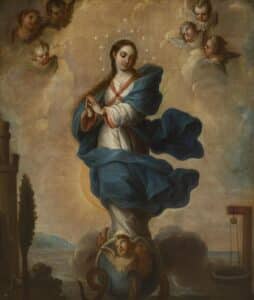
Mary comes as the King’s virgin bride and the Mother of God. She comes as the Immaculata, bringing with her the promise of a new creation.
The Church would not define the dogma of the Immaculate Conception for another three centuries. Yet the Nican Mopohua clearly reflects this belief, that the Mother of God has been preserved from all stain of original sin. This is a point that I believe is worthy of deeper theological and historical study.
Revealing her identity to Juan Diego, she declares: “I am the Perfect Ever Virgin Holy Mary.” Throughout the account she is called “Perfect Virgin,” “Most Holy.”
She first appears to Juan Diego on Dec. 9, a date that Eastern Christians have celebrated since the seventh century as the feast of Mary’s conception in the womb of St. Anne.
Bishop Zumárraga, whose Franciscan order was the great promoter of this dogma, understood her coming on this date to be a sign. He wanted to dedicate the Church at Tepeyac to the “Conception of the Mother of God,” he later wrote, because “God and His mother wanted to perform this mercy for this land.”
Coming as the Immaculata, Our Lady announces a new beginning for Mexico and for all the lands of the Americas.
When they first met, Juan saw the earth come alive, and he wondered if he had crossed over into Xochitlalpan, the “Land of Flowers,” the paradise of his ancestors. In their last meeting, as he again stands on top of Tepeyac Hill, Juan is certain: “I saw that it was the Flowered Land (Xochitlalpan),” he told Bishop Zumárraga.
Mary Immaculate herself is the paradise Juan’s people had longed for. She is the new Eden, the divine garden in which God has chosen to dwell.
She uses the hill of flowers, the very paradise of the natives, to “paint” her image on the tilma with her own hands. In the image she paints, she wears a flowered garment. It is as if Our Lady is portraying herself as the Flower Land. In the Child she brings in her immaculate womb, paradise has begun to flower on earth. In the Immaculata, a new heaven and a new earth have come.
The race of God’s children
The woman of the tilma is the virgin prophesied by Isaiah. For the indigenous, her virginity is symbolized by the way her hair is parted and hangs down loose. The dark purple sash tied above her waist is the sign that she is with child.
Our Lady’s one knee is bent in gentle motion, as if she is dancing or rocking back and forth. Her hands are folded in prayer above her womb and, beneath her hands, in the center of her tunic, is the four-petaled jasmine flower, which the natives understood as a sign that the Child she carries is divine.
God’s temple in heaven has been opened, and Our Lady has come as the new Ark of the Covenant, the new dwelling place of the living God on earth. We recall the prophecy: “Behold, a virgin shall conceive and bear a Son, and His name shall be called Emmanuel (which means, God with us).” We hear the heavenly voice from Revelation as the bride descends: “Behold, the dwelling of God is with … His people.”
The maiden’s head inclines slightly to one side, her eyes are cast down, as if she is praying to the Child within her, or praying for her children on earth. We see the start of a small smile on her lips. Her expression is kind, merciful. Just as Juan Diego described her. She is drawing us toward her, we feel her love. She speaks to us as she spoke to him. We are her little sons, her little daughters, her youngest and dearest. “I am honored to be your compassionate mother,” she tells us.
The mother of Jesus is there.
Her skin is olive and bronze, her features are mestizaje, a mix of peoples and cultures — we can detect Spanish, Indian, Mexican, Jewish, and more. This is Mary of Nazareth, the virgin betrothed to a man called Joseph, of the house of David. But her clothing is indigenous, she speaks in the native tongue, her features do not belong to any one race.
She is the New Eve, the mother of all living, the mother of “all people.” She is the mother of the Church, the family of God in which every man and woman, of every race, language, culture, and nationality, finds a home. In the Son she bears, God’s promise to Abraham, made at the dawn of salvation history, finds fulfillment: “In your posterity shall all the families of the earth be blessed.”
In the Morenita’s face we see the beautiful truth of our humanity, our great dignity and equality as God’s sons and daughters, created in His image. We see what the apostles saw — that in Jesus there is no longer slave or free, Greek or Jew, we are all children of God and heirs to the promise of Abraham.
This maiden is the mother of the new humanity — the race of the children of God. This was what one of the great 20th-century saints, St. Josemaría Escrivá, said after he spent nine days in prayer before the holy tilma. Speaking later to farmworkers in the Mexican state of Morelos, St. Josemaría said: “No one is greater than anyone else — no one! We are all equal! Each of us is worth the same, worth the blood of Christ. Just think how wonderful this is. For there are no races, there are no languages. There is only one race: the race of God’s children.
“Look at the beautiful, magnificent face that Holy Mary left in the hands of Juan Diego, on his cloak. You can see that her features are both Indian and Spanish. For there is only the race of God’s children.”
 A smile in the eyes of all the other saints
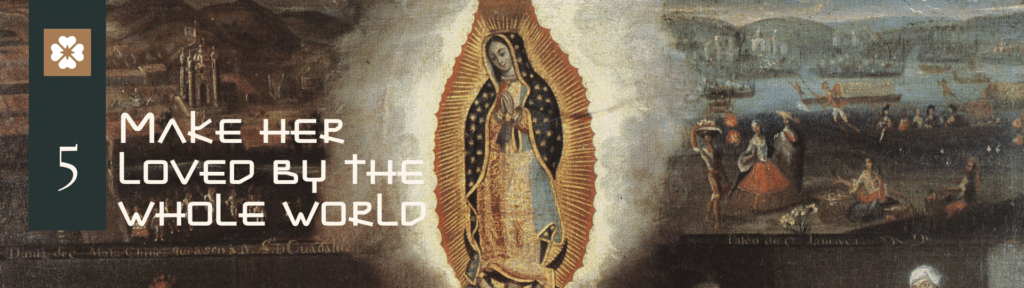
The miraculous image of Holy Mary of Guadalupe is an American icon, a self-portrait that the mother of Jesus has given us as a window into our souls and into God’s designs for the world.
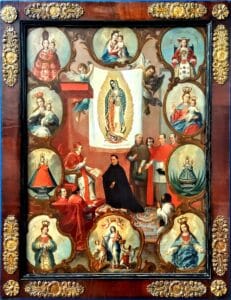
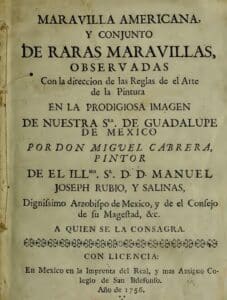
Don Miguel Cabrera, the great painter of New Spain, was commissioned to examine the tilma and make a faithful copy of the miraculous image. In 1756, he published his findings under the title “Maravilla americana” — “The Wonder of America.” The image, he concluded, was a “divine portrait” made “by a brush entirely of heaven.”
From this heavenly portrait, this wonder of America, Our Lady’s dark eyes look upon us. We see our own reflection in these eyes, as if we are looking into a mirror that reveals the mystery of our souls.
Her eyes, heavy with emotion, have fascinated the faithful since the beginning. What does Our Lady see? What stirs in her heart, as she gazes down upon us across the centuries?
Scientists have made their own inquiries into the virgin’s eyes, studying them using the most advanced magnifying instruments and other technologies. Some of these studies have produced findings for which it seems there are no natural explanations. Most famously, a Peruvian engineer claimed to have detected in her eyes the reflections of Bishop Zumárraga and others who were in the room when the flowers fell from Juan Diego’s tilma. These studies only deepen the mystery that surrounds this American icon, this wonder of America.
For me, the most beautiful mystery of Our Lady of Guadalupe’s eyes is what she herself called “my compassionate and merciful gaze.” In her gaze, I know that she knows my whole life, that she loves me with a mercy beyond all telling.
I hear her voice: “I am the mother of fair love, of reverence, of knowledge, and of holy hope.” I believe her. Totally. She hears my cries, knows my sadness, my troubles, my dreams and joys. I love her and I trust in her love for me.
I trust Our Lady of Guadalupe because she has walked the valley of the shadow of death with her Son. She has known the night of faith. I trust her because she has shown me her face. Not an artist’s idea of what she might look like.
She painted her own picture for me with roses and flowers of precious bloom. I see in her eyes what the great poet Dante saw: “A beauty smiling, which was the gladness within the eyes of all the other saints.”
The mother of Jesus is there in the image she left for us at Tepeyac. And where the mother of Jesus is, her Son cannot fail to be. As we gaze on her image, we can feel Jesus’ heart beating beneath her own, beating for the love of you and me and for the love of all the peoples of the earth.
This is what the native peoples of that first generation felt when they gazed upon this divine image.
In the years after the apparition, the missionaries describe natives traveling for days on foot during the rainy season, carrying their children on their backs, crossing rivers and streams, braving every danger to be baptized. They came by the thousands.
“It was an enormous multitude that came, for besides the sound there were many lame and crippled, women with children on their backs and old men, white-haired and of great age,” wrote the Franciscan Friar Toribio Motolinía.
In the first 10 years following Our Lady’s apparitions, some estimate that between 9 and 10 million were baptized. The missionary Fray Gerónimo de Mendieta, in his “Historia Eclesiástica” (“Church History”) described the scene: “Grown people and young, men and women, healthy and ill went. The old baptized people brought their children to be baptized, and the young baptized brought their parents; the husband brought his wife, and the wife, her husband. … At the time of their baptism, many received that sacrament with tears in their eyes.”
We should cherish the testimonies from the first evangelization of the Americas!
Our Lady’s image converted an entire continent, a sign for all ages that the mother of Jesus was there. She is still here.
Chapter 5/Make her loved by the whole world
Whenever you write or speak about spiritual matters, you hope you are making a connection, saying something people need to hear, words that will touch their hearts and give them hope; words that will tell them God is near.
I remember something Pope Benedict XVI said during his retirement. A journalist asked why he bothered to write out his Sunday sermon each week for the Mass he celebrated for his small household staff. “You write sermons for four or five people?” he said, surprised. The Pope laughed: “Why not? Certainly! Whether there are three or twenty or a thousand. The Word of God must always be present to people.”
I think about Benedict a lot, I reflect on his writings and ask his intercession for my ministry. That day in April, 16 years ago now, when he appointed me to be the next archbishop of Los Angeles, continues to be a great blessing in my life. And his words here reflect a truth that every one of us in the Church should keep in mind, especially those of us who are pastors. Our purpose is to reveal God, to make His Word present to the people of our time. We can never write or speak casually about Jesus. Or about Our Lady.
 With Our Lady, we always want our words to do her some beautiful service. But so many wonderful words have already been written and spoken and sung about her — by Popes and poets, saints and mystics. What more could we add? Truly, she is “our tainted nature’s solitary boast,” as the poet Wordsworth said. Or, as the Nican Mopohua says: “Her perfect grandeur exceeded all imagination.”
Writing this letter, I can appreciate how unworthy St. Juan Diego felt and why he wanted Our Lady to send someone else to be her messenger. “I am really just a man from the country,” he said. “I’m the porter’s rope, I’m a back frame, just a tail, a wing. I myself need to be led.”
As I conclude these reflections, I am writing from a small chapel in Los Angeles, more than 2,000 miles and nearly 495 years away from that place where Juan Diego first met Our Lady and where his miraculous tilma hangs. But we are connected.
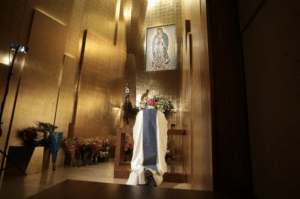
This chapel in the Cathedral of Our Lady of the Angels contains what is believed to be the only relic from the tilma: a tiny square of the fabric, no more than a half inch in size. It is encased in a gold and glass reliquary and presented in a bronze sculpture of St. Juan Diego, done in a style that reminds me of indigenous art. It is fitting that the relic is placed in Juan’s heart.
I had the honor to dedicate this chapel in my second year as archbishop, to mark our cathedral’s 10th anniversary. The walls are tall and narrow and colored brilliant gold; a radiant mosaic of Our Lady of Guadalupe sits high on the back wall. I like to come here in the afternoons sometimes to pray and gather my thoughts, after the pilgrims have gone for the day and it is quiet.
As the years pass, more and more I can see that throughout my life, Our Lady of Guadalupe has been there, holding me in the tenderness of her maternal heart, guiding me with her gentle hand. I hear her voice even now: “Are you not in the hollow of my mantle, in the crossing of my arms?” I realize that I am. And I always have been.
When I moved to Mexico City to go to college, I started making frequent pilgrimages to the basilica to pray before her image. I was already serious about my faith. I had decided in my early teenage years to try to go to Mass every day, as my father did. This practice shaped my prayer and spirituality and made me more aware of what God was calling me to do with my life.
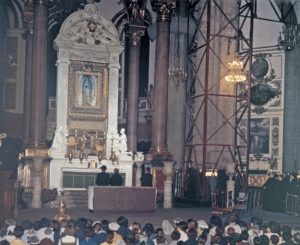 A few months after I moved, in May 1970, the founder of Opus Dei, now St. Josemaría Escrivá, arrived there on pilgrimage to pray a novena. I was privileged to be part of the film crew in charge of documenting his time at Tepeyac.
Msgr. Escrivá was devoted to Mary, and there was an almost childlike simplicity about his devotion. When he was in his late teens and early 20s he had gone regularly to the Basilica of Our Lady of the Pillar in Zaragoza, Spain. There he would pray to know his vocation. He also had a small statue of the Virgin of the Pillar that he would pray before in his home. “My Lady, let it be!” was how he prayed. “May whatever God wants me to do be done!”
When he came to Our Lady’s basilica in Mexico City, it was a time of turmoil and confusion in the world; the Church, meanwhile, was struggling as it implemented the doctrine of the Second Vatican Council. He said he came to pray for the Pope, for the Church, and for direction in his own life and ministry.
For nine days he prayed in a little balcony where he could be closer to the divine image. Looking back now, I can see how Our Lady was at work. During those nine days, my love for her grew, and what God wanted for my life became clear. I knew with certainty that I wanted to give my life completely to Jesus.
At the end of those nine days, Msgr. Escrivá said: “In the end we didn’t pray for anything, we just said to her in all confidence, ‘Fiat! Let it be done!’ ”
I wanted to live that way, too. And I knew that by God’s grace, and with Our Lady’s help, I could do it.
My Lady, let it be!
I often think that the Latin word fiat, “let it be done,” the word Our Lady spoke to the angel at the Annunciation, is the hardest word. It is so hard for us to let go of our agendas, our need to feel in control, our desire to do what we want to do. So hard to put our lives in God’s hands. To say as Mary did and Jesus did, “Not my will, but Thy will be done.”
Yet this is the way of the saints, and we are all called to be saints. And even if we are not conscious of it, in the depths of our beings, we all want to be saints. We want to be pure, we want to be forgiven, we all want to love and to be loved. With Our Lady’s help, we can do it, we can become the saints we are made to be. We rediscover this truth in the Tepeyac story.
Mary has always been the memory of the Church, as mothers are in the family. Only Mary knew what happened before Jesus became a public figure, all those stories that we have from the first pages of the Gospels, the joyful mysteries we pray in the Rosary. These mysteries are the memories of her maternal heart. “Mary kept all these things, pondering them in her heart,” St. Luke says.
In the depths of her immaculate heart, Mary carries the memory of the Incarnation and the beautiful truth it holds: that God so loved this world, that through Mary He sent His only Son to set us free and show us how to really live. That through her, the Word became flesh, humbling Himself to share in our humanity, so that we can share in His divinity.
Mary brought her Son to the New World, just as once she brought Him to her kinswoman Elizabeth’s house. Her apparition at Tepeyac was a visitation. She came to us as the mother of our Lord, bearing the blessings of the fruit of her womb.
As she did in the biblical story, Mary’s soul magnified the Lord at Tepeyac. “I will show Him, I will exalt Him upon making Him manifest,” she proclaimed to the Americas. “I will give Him to all people in my personal love!”
I was at a Christmas party in Denver once. At the time, I was an auxiliary bishop, also serving as rector of the Cathedral Basilica of the Immaculate Conception. It was a joyous time as we were all getting ready for the coming of Jesus.
The host of the party asked all the guests to select a small present from a basket on a table. I looked for the smallest one and found it was a little image of Our Lady of Guadalupe. I was happy to have it, and tucked it into my pocket.
The next morning, I received a phone call from the papal nuncio informing me that the Holy Father had chosen me to be the new archbishop of San Antonio. Looking back, again I see Our Lady’s hand.
I had served for a time as a priest in San Antonio, so I knew its history. I knew that in 1731, San Antonio became the first place in what is now the United States to have a parish dedicated to Our Lady of Guadalupe.
That first parish eventually became San Fernando Cathedral, seat of the archdiocese where I would celebrate the Eucharist and preach each Sunday. In my time there, I was proud to mark the cathedral’s 275th anniversary by declaring a jubilee year.
I still carry that little image of Our Lady of Guadalupe. And it was during those years in San Antonio that I first began to reflect on the stories of the great missionaries and the deep Catholic roots of America.
I cannot say this enough: as a Church, as a nation, we need to recover an awareness of the spiritual foundations of America and the Americas. The parish that became San Fernando Cathedral was established a year before the first president of the United States was born and 45 years before the Declaration of Independence. Our Lady of Guadalupe was being venerated in this land a generation before this country even had a name.
Long live Christ the King and Our Lady of Guadalupe!
As I pray before her relic, I am reflecting that Our Lady of Guadalupe is still at work in the history of our country and in the histories of all the countries of the Americas.
This relic was a gift to my predecessor, Archbishop John J. Cantwell, from the Archbishop of Mexico City, the Servant of God Luis María Martínez. Archbishop Martínez was a holy priest and spiritual writer. He was also a quiet hero of the Church’s resistance to the persecutions that followed the Mexican Revolution of 1917. I always admired his first words to his people: “I come to promise you one thing, that I will give you my life.”
During the persecutions in the 1920s and 1930s, Archbishop Cantwell was another quiet hero, working with the Knights of Columbus and other lay organizations to welcome thousands of refugees who were fleeing the terrors, helping them make a new home in Los Angeles. In 1941, Archbishop Martínez gave him this precious piece of the tilma to thank him for his courage and friendship with the Mexican people.
The repression in Mexico was the most prolonged and violent state persecution of the Catholic Church in the history of the Americas. Tens of thousands were killed for their faith. Sadly, this history is now largely forgotten, even among leading Catholics in Mexico and the United States.
As I write these words, the Mexican bishops have recently issued a beautiful message to mark the 100th anniversary of the anti-Catholic law that enabled the persecution. This law criminalized much of the Church’s work and ministry and subjected priests to state control, effectively outlawing public worship. For the first time in nearly 400 years, tabernacles stood empty of Christ’s presence across the land. Churches, seminaries, convents, and other Church properties were seized; many were closed, desecrated, or destroyed.
Priests were executed by firing squad; some were gunned down while celebrating Mass. Religious sisters were driven from the country. Ordinary Catholics, even teenagers, were imprisoned, tortured, and murdered. The regime strung up many of its victims on telegraph poles along the highways.
At a decisive moment in the revolution, the government had conspired to cut off the Mexican people’s faith at its roots — by trying to destroy the miraculous image of Our Lady of Guadalupe. In November 1921, a man with ties to the revolutionary leadership planted a bomb in a flower arrangement and placed it beneath the image in the old basilica at Tepeyac.
When the bomb went off it destroyed the altar, crumbled the marble on the floor, and shattered the shrine’s windows; the force of the blast damaged buildings within a half-mile radius. The candelabra and bronze crucifix on the altar were left twisted and disfigured. The tilma was untouched, not even a scratch on the glass case or frame. Today, you can still see the mangled crucifix on display in the rear of the sanctuary in the new basilica. They call it “El Cristo del Atentado” (“Christ of the Attack”).
The revolutionaries believed they could wipe the memory of Catholicism from the Mexican soul. They were wrong.
I grew up in Monterrey in the generation that followed those persecutions. We knew the martyrs and we knew their stories. We knew that for every martyr we could name, there were countless hidden saints whose heroic witness was known only to God, many of them ordinary fathers, mothers, and grandparents.
We knew the words on their lips as those witnesses went to their deaths: “Long live Christ the King and Our Lady of Guadalupe!” We wanted to live by those words.
The town of Our Lady of the Angels
When I became archbishop of Los Angeles in March 2011, I realized how much the Mexican persecution had left its mark on the family of God here, as it had left its mark on San Antonio and other local churches throughout the southwest.
Of course, the Church in Los Angeles is drawn from nearly every country on earth, especially those in the Americas. But there has always been a special bond with the Church in Mexico. This bond was only strengthened by Archbishop Cantwell’s hospitality. The refugees he welcomed became neighbors, coworkers, fellow parishioners, teachers, and parish and community leaders, contributing their own gifts to an already vital Mexican-Catholic culture.
This heritage makes Los Angeles distinct and our Church unique. I am still struck by it as I travel throughout the archdiocese. The original refugee generation is now passing, but the legacy of their faith, hard work, and sacrifice endures. I see it in you, in your children and grandchildren, and in our churches, schools, and communities.
It is beautiful beyond words to see your love for Jesus and His mother, for your families and the Church. Over these past 15 years, it has been the joy of my life to pray with you, to celebrate the Eucharist for you, to baptize, confirm, and marry your children, and to celebrate your parents’ and grandparents’ anniversaries. I love hearing you sing and I love our conversations and the meals we share.
At the heart of your homes, I always find Our Lady of Guadalupe, just as she was at the heart of my family’s home when I was growing up. We are all Guadalupanos, Our Lady’s dear sons and daughters. Keep loving her as she loves you! Keep teaching your children and their children’s children to love her, too!
St. Junípero Serra and his brother Franciscans named Los Angeles for the little church in Assisi, Italy, where St. Francis first heard Jesus’ call. They called this city “El Pueblo de Nuestra Señora de los Angeles de Porciuncula” (“The Town of Our Lady of the Angels of Porciuncula”).
Los Angeles is surely the City of Our Lady of the Angels. But Los Angeles is also the City of Our Lady of Guadalupe.
As you go about this city, you find Our Lady of Guadalupe everywhere, often in the most unexpected places. Los Angeles is the great city of street art, and murals of Our Lady appear on the walls of businesses and community centers, in alleys and parking lots. You see her at the bakery, the furniture store, the car wash, the poultry market, the flower shop.
Our Lady goes with us as we push our carts to the market, walk our kids to school, and go about our daily lives. On these streets and sidewalks you can feel her love — and how much we depend on her. She looks down from these murals as if to say: “Am I not here, I who have the honor to be your mother? Are you not in my shadow and under my protection?”
In December, I will lead our 95th annual procession in honor of Our Lady of Guadalupe. This is the city’s oldest religious procession, started in 1931 by the families who fled the persecutions in Mexico.
I love this procession because it is a glorious celebration of the diversity of the family of God here. On that day, the whole Church comes out — bishops and priests, deacons and seminarians, religious and consecrated men and women; there are indigenous dancers, equestrian groups, singers and musicians; and thousands of the faithful, from great-grandparents to babies in their mothers’ arms. We all come to give thanks to Our Lady of Guadalupe, processing through the streets of East Los Angeles until at last we gather for a joyous celebration of the Eucharist in the local college football stadium — because no church is large enough to hold us all!
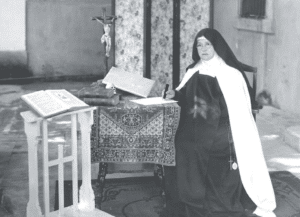 A city of saints
Los Angeles is a city of saints, and our local saints are born from Our Lady of Guadalupe’s heart.
The first local saint I discovered here was a Mexican woman, a refugee from the persecutions that a friend told me about shortly after I arrived in Los Angeles: Venerable Mother María Luisa Josefa of the Most Blessed Sacrament. They called her Mother Luisita.
A wife and widow from a privileged background, she became a contemplative nun who ran hospitals and orphanages for the poor before being driven underground by the repression. Exiled in Los Angeles, Mother Luisita and her sisters ministered without pay, teaching children and caring for the poor and sick.
Mother Luisita founded the Carmelite Sisters of the Most Sacred Heart of Los Angeles, whose ministry and prayer continue to shape the spiritual character of our local Church, and whose friendship has been a blessing I have cherished during my years here.
Much of her spiritual legacy was handed down through letters written on the backs of envelopes and scraps of paper and carried secretly across the border to her sisters still ministering in Mexico. In these letters, Mother Luisita’s devotion to Our Lady of Guadalupe shines through.
She encouraged her sisters to stay close to Our Lady in their exile: “You love her so very much. Give her as many gifts as you are able, even if you are in another country now. Be faithful to such a loving mother and queen of our nation.”
I turned to Mother Luisita’s writings in my first Mass at the Cathedral of Our Lady of the Angels, when I was welcomed as coadjutor archbishop of Los Angeles in May 2010:
“Venerable Mother Luisita would tell everyone: ‘For greater things you were born!’ That is it, my friends! That is the Good News we are called to proclaim to our city, to our country, throughout this continent and world. For greater things we were born! Each of us has been made for love and for great and beautiful things. There is no soul that God does not long to touch with this message of His love! And He wants to touch those souls through us.”
Our Lady of Guadalupe revealed this beautiful truth to the Americas just a few decades after the coming of the explorers and missionaries from Europe. And this truth still speaks from the heart of the sacred image she left for us, the promise of God’s saving love: “I will give Him to all people in my personal love, Him that is my compassionate gaze, Him that is my help, Him that is my salvation.”
More than ever, Los Angeles is a city of saints. And you and I belong to the next generation of witnesses to the living God, the loving God who comes to save us.
Like Mother Luisita, like the local saints who have gone before us and go with us, we need to love Our Lady of Guadalupe very much. We need to bring all our gifts to her mission. We need to welcome her as the mother and queen of our nation. Her promise is now ours to carry.
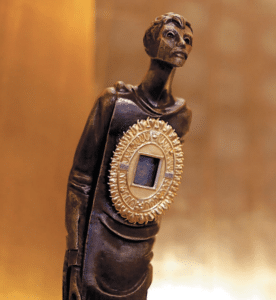 Let the Americas hear this holy cry
As I pray before this holy relic, I recall the words of Scripture: “Since we are surrounded by so great a cloud of witnesses, let us … run with perseverance the race that is set before us, looking to Jesus the pioneer and perfecter of our faith.”
We walk in the footsteps of Jesus and also in the company of the great cloud of witnesses who have run this race before us, who lived and died bearing witness to Christ the King and Our Lady of Guadalupe.
I think of Blessed Anacleto González Flores. He was a lawyer, a catechist, a husband and father of two. During the persecutions in Mexico he was tortured for his faith, his body beaten and broken, the skin ripped from the soles of his feet. Before they ran him through with a bayonet, he forgave his killers. Witnesses say these were his final words: “Let the Americas hear this holy cry: I die, but God does not die!”
As we approach the 500th anniversary of the Guadalupe apparitions, the Church is once again called to make this holy cry heard throughout the Americas.
We live in a moment when belief in God is fading from our nation and across our hemisphere. Our societies grow more secularized with each passing year. So many of our neighbors and, sadly, so many of our young people are living as if God does not exist.
Our Holy Father Pope Leo XIV warns that we are also confronting a new industrial revolution.
The revolution of artificial intelligence (AI) is about more than technology and the economy. AI will change the way people see the world. It will cause them to question what is real and true and what is not. At stake is the future of what it means to be human, what it means to be alive.
Already we see the signs around us: without God, the world loses its meaning; human life loses its measure and purpose; people are unspeakably lonely, no longer knowing what to live for or why. New injustices and crises arise in our societies as we turn further away from God.
But we also see in our societies a new longing for truth, beauty, and goodness. Our neighbors are seeking love and meaning; they are seeking God. Especially our young people.
With all these lights and shadows, this is the “new world” in which we are called to live our faith, and in which our children will raise their families and hand on the faith. This is the new mission territory that the Catholic Church in the Americas is called to evangelize.
Pope Leo is calling us to renew our desire to live out our mission to the Americas, to rediscover and to spread the message that Our Lady came to bring at the dawn of the evangelization of our continents.
“On Tepeyac, she awakens in the inhabitants of America the joy of knowing that they are loved by God,” the Holy Father has said. Our task now is to continue the work of those first evangelists in whom he says “the message of Guadalupe [was] transformed into a missionary impulse.”
In our mission, we are surrounded by that great cloud of witnesses, the holy men and women of the Americas:
- contemplatives like Rose of Lima, Dina Bélanger, Mariana of Quito, and Teresa of the Andes;
- pastors like Toribio de Mogrovejo, Junípero Serra, François de Laval, Rafael Guízar Valencia, John Neumann, and Ezequiel Moreno;
- servants of the poor and suffering like Peter Claver, Martín de Porres, Juan Macías, Damian of Molokai, Marianne Cope, Alberto Hurtado, Rose Philippine Duchesne, Dulce of the Poor, and Pedro de San José de Betancur;
- great founders and teachers like Frances Cabrini, Elizabeth Ann Seton, Katharine Drexel, Marguerite Bourgeoys, Marguerite d’Youville, and María Antonia de Paz y Figueroa, “Mamá Antula”;
- indigenous servants and messengers like Juan Diego and Kateri Tekakwitha;
- missionaries like Francisco Solano, José de Anchieta, Alonso de Barzana, Laura Montoya, José Gabriel del Rosario Brochero, and Antonio Margil de Jesús;
- martyrs like Roque González and his companions, Isaac Jogues, Jean de Brébeuf and their companions, Philip of Jesus, Miguel Pro, Óscar Romero, and José Sánchez del Río.
There are so many more. Across five centuries and across these continents, the promise of Guadalupe has borne fruits of holiness — in saints and martyrs, missionaries and mystics, servants of the poor and defenders of human dignity. Their lives testify that Our Lady of Guadalupe has never abandoned her children in the Americas. The mission begun at Tepeyac is not finished
And now their witness passes to us.
The holy cry must become our own and we must make it heard again throughout the Americas: God is alive! His kindnesses are not ended, His mercies are not spent. His plan of love continues to unfold in our time.
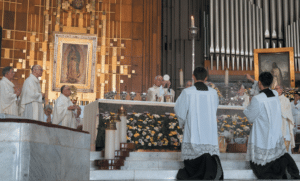 His tilma became the sign
The mystery of Tepeyac, the mystery of God’s plan for the Americas, is revealed in the miraculous image that still hangs behind the altar there.
The Nican Mopohua tells us that when Juan Diego opened his white tilma and the flowers fell to the floor, “then and there his tilma became the sign.” The tilma is not simply an image, a representation, a picture that signifies the Virgin. In the tilma, Our Lady of Guadalupe gives herself to us.
The thousands of natives who traveled for days and weeks to see this image and be baptized understood that. They were not converted by a painting. Through the image they came to a true encounter with the Mother of all Living, the Mother of the True God, who loved them and came to remain with them.
The millions who still stream to Tepeyac each year are not coming to look at a picture in an exhibition. They are coming for that same encounter: to meet the Mother of God, to behold their mother. In the sacred tilma, we are caught up in the love of the true and living God, whom she brings to us.
Then and there, his tilma became the sign! It is still the sign. The sacred image is the message of Guadalupe.
Father Bartolomé Felipe de Ita y Parra was a Mexican priest and one of the great preachers of New Spain. On Dec. 12, 1731, he delivered a powerful sermon marking the 200th anniversary of the apparitions. Preaching in the old basilica, in the presence of the sacred tilma, he called the image “a continuous apparition,” through which Our Lady’s presence abides across the centuries.
She is “the Lady of the Ages and the Queen of the Centuries,” and the holy tilma is a heavenly work of art. “That beautiful image,” he said, “recapitulates in itself all of time — it joins all the years and contains all the centuries.”
Father Ita y Parra believed in the power of the sacred tilma to heal hearts, save souls, and convert the nations. We should too.
“This holy image became the marvelous instrument for their [the natives’] conversion,” he reminds us. As we approach this 500th anniversary, may we believe in the power of this holy image to once again touch hearts and bring people to God.
The tilma is more than a painted cloth. It is an American icon. The wonder of America. Then and there, his tilma became the sign. It is still the sign.
Carry the image of Our Lady of Guadalupe
There is one more Los Angeles saint whose story I want to tell, because her life brings us back to the heart of what I have been trying to say. She too was a refugee from the persecutions in Mexico. She was a mystic and a missionary, and her vocation was born in the heart of Our Lady of Guadalupe. Her name was Blessed María Inés Teresa Arias.
Her story is beautiful because it is so ordinary. Manuelita, as she was called, was born in 1904 and grew up in a large Catholic family in Nayarit, Mexico, the fifth of eight children. She went to daily Mass with her father and worked in a bank. She was active in her parish, had a heart for the poor, and enjoyed her friends and family.
When Manuelita was 20, a cousin gave her the autobiography of the Little Flower, St. Thérèse of Lisieux. From that time on, she felt a deep desire to consecrate her life to Jesus Christ. “I not only found my vocation,” she later said. “I found God within me in a very special way.”
She joined the Poor Clare Sisters in Mexico City, even as the persecution of the Church was growing. In 1929, she and her fellow Poor Clares were driven into exile and came to Los Angeles.
Blessed María Inés professed her temporary vows in one of our mission churches on Dec. 12, 1930, the 399th anniversary of Our Lady’s giving of the sacred tilma. On her knees before the image of Our Lady, she heard the Virgin speaking in her heart, promising to accompany and support her in all her apostolic works.
“That day [Our Lady] made me a promise,” she said. “And I solemnly promised her in the bottom of my heart that I would make her loved by the whole world.”
Returning to Mexico in 1931, she founded a new religious order, the Poor Clare Missionary Sisters of the Blessed Sacrament. She gave her sisters this mission: “To carry the image of Our Lady of Guadalupe, so that she, through her maternal tenderness, would bring her Divine Son to live in the hearts of those who hunger for God without knowing it.”
For the next 50 years, Mother María Inés did just that. She and her sisters carried the image of Our Lady of Guadalupe to the ends of the earth, establishing missions in Mexico, Japan, Costa Rica, Africa, India, Russia, and elsewhere.
Her order continues to bear fruit here in Los Angeles. And I believe Blessed María Inés gives us a beautiful way to think about our own calling as disciples.
We are approaching two great anniversaries: in 2031, the Jubilee of Our Lady of Guadalupe; and in 2033, the Extraordinary Jubilee marking 2,000 years since the death and resurrection of Our Lord. As these great jubilees draw near, it is time to renew our faith and take up our mission.
Now is the hour to live our faith with attentive hearts, with new seriousness and new joy; to go deeper in prayer and study, to grow in our knowledge and love for Jesus and His mother; and to embrace more fully our responsibility to spread the faith and bring others to Jesus.
Now is also the hour for a new commitment to the continental mission, to the evangelization of the Americas, beginning in our own country. Missions and more missions! That is still what our country needs, as St. Junípero Serra said.
Each one of us must carry the image of Our Lady of Guadalupe into our world today, into our homes and neighborhoods, into the places where we work and go to school, into every area of our society. We need to make this image once again a divine instrument for the conversion of the peoples of our lands. We need to bring Jesus Christ to every heart that hungers for God. And we need to make Our Lady loved throughout the world!
From Tepeyac, Our Lady of Guadalupe is still calling us to help build her temple in this new world. She is still calling us to make the living God known and to show our neighbors the way to find Him.
Five hundred years on, Our Lady of Guadalupe is still looking for messengers. Let each of us answer with our whole lives: “I will go with gladness! May whatever God wants me to do be done! My Lady, let it be!
Mother of fairest love
In the Church, we should conclude everything we do — our prayers, our teaching, our preaching, all our apostolic labors — by turning to Our Lady, the Mother of Fairest Love. Our last word must always be a prayer to her.
Pray for me, and I will pray for you. And I offer this prayer for all of us, Guadalupanos, the family of God here in the Archdiocese of Los Angeles.
Prayer to Our Lady of Guadalupe,
for the 500th Anniversary of her Apparitions
O Holy Mary of Guadalupe, our mother,
We love you and we give you our hearts.
Look upon us with your merciful gaze.
Be our joy and protect our families.
Fill our homes with love and
keep our children always close to your Son.
Guide us as we carry your message and
continue your mission in the Americas.
Help us to hear the cries of the poor,
and to bring Jesus to every heart that longs for Him.
Make us holy like Juan Diego,
and make our hearts like Tepeyac,
a place where your image shines and Jesus lives,
and where His love goes forth
to blaze a trail for our brothers and sisters.
Pray for us and let nothing trouble our hearts.
Bring us at last to the top of the hill,
that we might see the Flowered Land,
the beautiful paradise of heaven,
where we will live forever with you and your Son
in the love that never ends.
We ask all this in the name of Jesus.
O Our Lady, let it be!
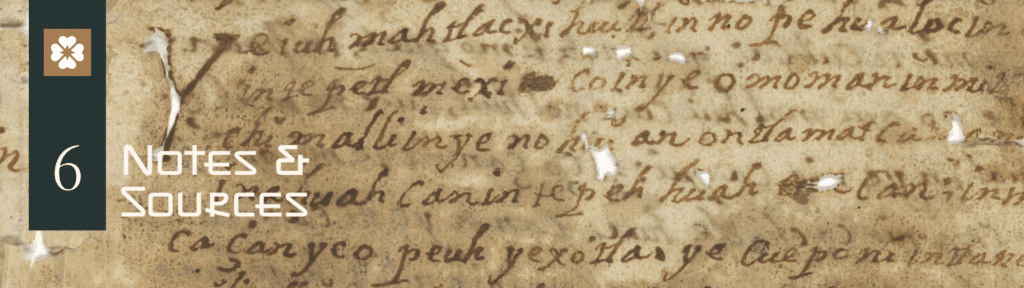
- Behold your Mother
Nican Mopohua — Translation and numbering from Instituto Superior de Estudios Guadalupanos, under the supervision of Msgr. Eduardo Chávez, in Carl A. Anderson and Msgr. Eduardo Chávez, Our Lady of Guadalupe: Mother of the Civilization of Love, preface by Archbishop José H. Gomez (Doubleday, 2017 [2009]), 171–183.
Behold your mother — John 19:26–27; Catechism of the Catholic Church, 2677, 2679.
All generations shall call me blessed — Luke 1:48
On private revelation and Marian apparitions — Frederick M. Jelly, OP, Madonna: Mary in the Catholic Tradition (Our Sunday Visitor, 1986), 190–195; Dicastery for the Doctrine of the Faith, Norms for Proceeding in the Discernment of Alleged Supernatural Phenomena (May 17, 2024), presentation and 10–23; Catechism, 67.
Born of a woman — Gal. 4:4; Eph. 1:10.
The vocation of humanity — Rom. 6:4; 8:21, 29; John 1:12–13; 1 John 3:1–2. Catechism, 1877; 2085.
All of his apostolic labors — Francisco Palou’s Life and Apostolic Labors of the Venerable Father Junípero Serra (1787) (Applewood, 2016), 19; Maynard Geiger, “Junípero Serra, OFM, in the Light of Chronology and Geography (1713–1784),” The Americas 6:3 (1950): 290–333.
One of the founding fathers — Pope Francis, Homily at the Pontifical North American College (May 2, 2015).
Missions, my Lord — St. Junípero Serra, Letter 129 (Aug. 22, 1778), in Writings of Junípero Serra, ed. Antonine Tibesar, 4 vols. (Academy of American Franciscan History, 1956) 3:249–255, at 255; trans. in Rose Marie Beebe and Robert M. Senkewicz, Junípero Serra: California, Indians, and the Transformation of a Missionary (University of Oklahoma, 2015), 357.
Nican Mopohua history — Anderson and Chávez, Our Lady of Guadalupe, 171–172; Eduardo Chávez, Our Lady of Guadalupe and Saint Juan Diego: The Historical Evidence (Rowman & Littlefield, 2006), 96–97.
- The Marian heart of America
Columbus was a man of faith — Leonard I. Sweet, “Christopher Columbus and the Millennial Vision of the New World,” The Catholic Historical Review 72:3 (July 1986): 369–382; Pauline Moffitt Watts, “Prophecy and Discovery: On the Spiritual Origins of Christopher Columbus’s ‘Enterprise of the Indies,’ ” The American Historical Review 90:1 (February 1985): 73–102.
New world that Jesus promised — Matt. 19:28.
Jesus would return — Acts 1:8; Matt. 19:28; 1 Cor. 15:24; 2 Pet. 3:13; Rev. 11:15; 19:16.
Ven. María de Ágreda — Marilyn Fedewa, María de Ágreda: Mystical Lady in Blue (University of New Mexico, 2010); Clark Colahan, The Visions of Sor María de Agreda (University of Arizona, 1994).
St. Teresa of Avila — Joseph F. Chorpenning, “Icon of Family and Religious Life: The Historical Development of the Holy Family Devotion,” in The Holy Family as Prototype of the Civilization of Love: Images from the Viceregal Americas (St. Joseph’s University, 1996), 3–39, at 21; Christopher Chadwick Wilson, “St. Teresa of Ávila’s Holy Patron: Teresian Sources for the Image of St. Joseph in Spanish American Colonial Art,” in Patron Saint of the New World: Spanish Colonial Images of St. Joseph, ed. Joseph F. Chorpenning (St. Joseph’s University, 1992), 5–18, at 12.
The day of the world is already reaching — John Leddy Phelan, The Millennial Kingdom of the Franciscans in the New World, 2d. ed. rev. (University of California, 1970), 23–24. Robert Ricard, The Spiritual Conquest of Mexico: An Essay on the Apostolate and the Evangelizing Methods of the Mendicant Orders in New Spain, 1523–1572 (University of California, 1974).
Born from the Christian mission — Eph. 3:9; Matt. 28:19–20; Mark 16:15; Luke 24:47.
“The history of all nations is called” — St. Pope John Paul II, Memory and Identity: Conversations at the Dawn of a Millennium (Rizzoli, 2005), 72.
The signs of the times — Matt. 16:3; St. Pope John XXIII, Humanae Salutis (“Human Salvation”), Apostolic Constitution for the Convening of the Second Vatican Council (Dec. 25, 1961); Second Vatican Council, “Gaudium et spes” (“Joy and Hope”), Pastoral Constitution on the Church in the Modern World (Dec. 7, 1965), 4, 11.
Shaped all the succeeding years of my pontificate — St. Pope John Paul II, Rise, Let Us Be On Our Way (Warner, 2004), 54–56.
Marian Heart of America — St. Pope John Paul II, Homily at the Basilica of Our Lady of Guadalupe (Jan. 23, 1999).
Learn from the mistakes of the past — St. Pope John Paul II, Message to the Indians of Santo Domingo (Oct. 13, 1992); Homily in Phoenix, Arizona (Sept. 14, 1987); Tertio millennio adveniente (“As the third millennium approaches”), Apostolic Letter on Preparation for the Jubilee Year 2000 (Nov. 10, 1994), 33, 35. Luigi Accattoli, When a Pope Asks Forgiveness: The Mea Culpa’s of John Paul II (Alba House, 1998), 157–164
The Spanish conquest was a disaster — Christopher Shanon, American Pilgrimage: A Historical Journey through Catholic Life in a New World (Ignatius, 2022), 11–78; Kevin Starr, Continental Ambitions: Roman Catholics in North America (Ignatius, 2016), 21–67.
The Dominican friar Antonio de Montesinos — J. Augustine Di Noia, OP, “Rigans Montes de Superioribus: Divine Wisdom in Teaching and Learning,” Angelicum 98:4 (2021): 401–410, at 407–408.
Love compelled — 2 Cor. 5:14.
Grace abounded — Rom. 5:20.
Bishop Zumárraga — Eduardo Chávez, Our Lady of Guadalupe and Saint Juan Diego: The Historical Evidence (Rowman & Littlefield, 2006), 1–8; The Americas 5:3 (January 1949): Special Issue Dedicated to the Memory of Don Fray Juan de Zumárraga, First Bishop and Archbishop of Mexico: Lewis Hanke, “The Contribution of Bishop Juan de Zumárraga to Mexican Culture,” 275–282; Carlos E. Castañeda, “Fray Juan de Zumárraga and Indian Policy in New Spain,” 296–310; Fidel de J. Chauvet, “Fray Juan de Zumárraga, Protector of the Indians,” 283–295. Donald V. Kurtz, “The Virgin of Guadalupe and the Politics of Becoming Human,” Journal of Anthropological Research 38:2 (Summer, 1982): 194–210.
Series of unusual natural events — Pablo Kay, “Understanding the key to the Guadalupe miracle,” Angelus (Dec. 7, 2018): 10–13.
Woman of the Magnificat — Luke 1:46–55.
The Flower World — Joseph Julian González and Monique González, Guadalupe and the Flower World Prophecy: How God Prepared the Americas for Conversion Before the Lady Appeared (Sophia Institute, 2023), 191.
- His name was Juan Diego
God chooses the weak — 1 Cor. 1:27–28.
The great callings in biblical history — Gen. 12:1–9; 1 Sam. 3; Isa. 43:1.
The mother of the true God [téotl Dios] — Carl A. Anderson and Msgr. Eduardo Chávez, Our Lady of Guadalupe: Mother of the Civilization of Love (Doubleday, 2009), 8–9.
Moses’ reluctance to lead the Hebrew people — Exod. 3–4; Jer. 1:6; Jonah 1:1–3.
“Battle of faith” — Catechism, 2592.
Doctor of the Church St. John Henry Newman — Meditations 1–2, in John Henry Newman, Prayers, Verses, and Devotions (Ignatius, 1989), 338–339.
“Do whatever He tells you” — John 2:5.
Called to sanctify this world — Mark 16:24; 1 Cor. 3:9; 1 Thess. 3:2; Col. 4:11, Catechism, 307, 2738.
“Let it be to me according to your word” — Luke 1:38.
“Here I am my Lord, I come to do your will.” — Ps. 40:6–9; Heb. 10:5–7; 1 Sam. 3; Mark 14:36; John 4:34; 6:38; Catechism, 606–607.
- The mother of Jesus was there
“And the mother of Jesus was there” — John 2:1.
Her Son cannot fail to be — St. Pope John Paul II, Homily, Feast of Our Lady of Lourdes (February 11, 1980); Heb. 13:8.
Mary in the life of Jesus — Luke 1:26–38 (Annunciation); Luke 2:1–7 (Birth in Bethlehem); Luke 2:22–38 (Presentation); Matt. 2:13–15 (Flight into Egypt); Luke 2:41–52 (Finding in the Temple); Luke 2:51–52 (Hidden Life); Mark 6:1–3; Matt. 13:54–58 (Son of Mary and Joseph); Matt. 12:46–50; Mark 3:31–35; Luke 8:19–21; 11:27–28 (Mary in the crowds); John 19:25–27 (at the foot of the cross); Acts 1:12–14; 2:1–4 (Pentecost).
Apparition to St. James — Venerable Mary of Agreda, The Mystical City of God, 4 vols. (Catholic Way, 2013 [1665]), 4:308–315 (nos. 352–359); St. Pope John Paul II, Homily at Marian Act of Consecration of Spain to Our Lady at the Basilica-Sanctuary of Our Lady of the Pillar in Zaragoza (Nov. 6, 1982).
Our Lady of Guadalupe in Extremadura — Pablo Kay, “Is ‘the other Guadalupe’ Spain’s best-kept Catholic secret?” Angelus (Oct. 22, 2021): 20–22.
Again we think of Revelation — Rev. 21:1–2, 10; Ps. 45:13–15.
Conception of the Mother of God — Eduardo Chávez, Our Lady of Guadalupe and Saint Juan Diego: The Historical Evidence (Rowman & Littlefield, 2006), 65–66.
Virgin prophesied by Isaiah — Matt. 1:23; Isa. 7:14; Rev. 21:2–5.
New Eve — Gen. 3:20.
Abraham’s posterity — Acts 3:25; Gen. 22:18. St. Pope John Paul II, Homily at the Basilica of the Annunciation, Nazareth (March 25, 2000).
In Jesus there is no slave or free — Gal. 3:26–28; 28; Rom. 10:12; Eph. 6:8; Col. 3:11.
St. Josemaría Escrivá in Morelos — Andrés Vázquez de Prada, The Founder of Opus Dei: The Life of Josemaría Escrivá, 3 vols. (Scepter, 1997–2002), 3:408–411.
Wonder of America — Miguel Cabrera, Maravilla americana, y conjunto de raras maravillas, observadas con la dirección de las reglas del arte de la pintura en la prodigiosa imagen de Nuestra Señora de Guadalupe de México (“The Wonder of America, and a Collection of Rare Wonders, Observed According to the Rules of the Art of Painting in the Prodigious Image of Our Lady of Guadalupe of Mexico”) (Imprenta del Real y Más Antiguo Colegio de San Ildefonso, 1756), 11–15. Spanish: “quedando en este divino retrato la pintura jamás antes vista, como de un pincel todo del cielo.” Paul Badde, María of Guadalupe: Shaper of History, Shaper of Hearts (Ignatius, 2009), 103–104.
Scientists have made their own inquiries — Anderson and Chávez, Our Lady of Guadalupe, 39–44; José Aste Tonsmann, Our Lady of Guadalupe’s Eyes (Self-published, 2012); Los ojos de la Virgen de Guadalupe: un estudio por computadora electrónica (Editorial Diana, 1981), and El secreto de sus ojos: estudio de los ojos de la Virgen de Guadalupe (Tercer Milenio, 1998).
The night of faith — Ps. 23:4; Catechism, 165.
A beauty smiling — Dante, Paradise, Canto 31, 134–135 (Henry Wadsworth Longfellow trans.); Pope Pius XII, Radio to Message to Italian Catholic Action (Dec. 8, 1953).
Fray Gerónimo de Mendieta — Chávez, Our Lady of Guadalupe and Saint Juan Diego, 65–87; Joseph Julian González and Monique González, Guadalupe and the Flower World Prophecy: How God Prepared the Americas for Conversion Before the Lady Appeared (Sophia Institute, 2023), 9–11, 228; Timothy Matovina, “The Origins of the Guadalupe Tradition in Mexico,” The Catholic Historical Review, 100:2 (Spring, 2014): 243–270, at 254–256.
- Make her loved by the whole world
Word of God must always be present — Pope Benedict XVI with Peter Seewald, Last Testament (Bloomsbury, 2016), 6.
Our tainted nature’s solitary boast — William Wordsworth, “The Virgin,” in The Ecclesiastical Sonnets (Yale University, 1922), 177.
St. Josemaría Escrivá’s novena — Andrés Vázquez de Prada, The Founder of Opus Dei: The Life of Josemaría Escrivá, 3 vols. (Scepter, 1997–2002), 1:133–134; 3:408–411. “Our Lady of Guadalupe and St. Josemaría Escrivá” (https://stjosemaria.org/guadalupe/).
Not my will — Luke 22:42.
Mary kept all these things — Luke 2:19, 51. St. Pope John Paul II, Memory and Identity: Conversations at the Dawn of a Millennium (Rizzoli, 2005), 147–152.
First parish in what is now the United States — Timothy Matovina, Guadalupe and Her Faithful: Latino Catholics in San Antonio, from Colonial Origins to the Present (Johns Hopkins University, 2005), 4, 12–13, 154.
I will give you my life — Archbishop Luis María Martínez, Am I Not Your Mother? Reflections on Our Lady of Guadalupe (Magnificat, 2023 [1943]); “Apostle of Guadalupe,” Columbia (May 2022), 14–17.
Persecution of the Church in Mexico — Episcopal Conference of Mexico, “The Bells of the Churches Fell Silent; Their Blood Spoke: The Memory of Our Martyrs, Religious Freedom, and the Building of Peace,” Message One Hundred Years after 1926 (July 31, 2026) [https://chilpancingochilapa.org/mensaje-a-cien-anos-de-aquel-1926-cem/]. Jean A. Meyer, The Cristero Rebellion: The Mexican People between Church and State, 1926–1929 (Cambridge University, 1976); Cristiada: The Mexican People’s War for Religious Liberty (Square One, 2013); Wilfrid Parsons, Mexican Martyrdom: Firsthand Accounts of the Religious Persecution in Mexico 1926–1935 (Tan, 1936); Archbishop José H. Gomez, “Foreword,” in Sister Timothy Marie Kennedy, In the Face of Darkness: The Heroic Life and Holy Death of Mother Luisita (Sophia, 2019), xiii–xix; Archbishop José H. Gomez, “Foreword,” in James Murphy, Saints and Sinners in the Cristero War: Stories of Martyrdom in Mexico (Ignatius, 2019); Archbishop José H. Gomez, “Foreword,” in Ruben Quezada, For Greater Glory The True Story of Cristiada: the Cristero War and Mexico’s Struggle for Religious Freedom (Ignatius, 2012).
Christ of the Attack — Carl A. Anderson and Msgr. Eduardo Chávez, Our Lady of Guadalupe: Mother of the Civilization of Love (Doubleday, 2009), 25, Paul Badde, María of Guadalupe: Shaper of History, Shaper of Hearts (Ignatius, 2009), 115.
Great city of street art — Sam Quinones, Our Lady of the Angels: The Virgin of Guadalupe on the Walls of Los Angeles (Angel City, 2026); Heather King, “Mother of LA’s streets,” Angelus (July 10, 2026): 30–31.
Mother Luisita — Ven. Maria Luisa Josefa of the Most Blessed Sacrament, Letter 131, in In Love’s Safekeeping: The Letters and Spiritual Writings of Mother Maria Luisa Josefa of the Most Blessed Sacrament, OCD, 2 vols. (Carmelite Sisters of the Most Sacred Heart of Jesus), 1:235. Archbishop José H. Gomez, Remarks, Mass for the Reception of the Coadjutor Archbishop (May 26, 2010); Archbishop José H. Gomez, For Greater Things You Were Born, Pastoral Letter on God’s Beautiful Plan of Love for Our Lives and Our World (Dec. 25, 2016), 6; Archbishop José H. Gomez, “Foreword,” in Sister Timothy Marie Kennedy, Unleashing Hope: The Biography of Venerable María Luisa Josefa of the Most Blessed Sacrament (Sophia, 2022).
Queen of our nation — Mother Maria Luisa Josefa of the Most Blessed Sacrament, Letters 305, 306, 312, in Love’s Safekeeping, 1:484, 486, 484.
Great cloud of witnesses — Heb. 12:1.
God does not die — Javier Olivera Ravasi, “Historia e historias,” Revista Yachay 35 (2018): 75–139, at 132.
New industrial revolution — Pope Leo XIV, Magnifica Humanitas (“Magnificent Humanity”), Encyclical Letter on Safeguarding the Human Person in the Time of Artificial Intelligence (May 15, 2026), 15.
Pope Leo XIV on Our Lady of Guadalupe — Message to Participants in the “Pastoral Theological Congress” on the Event of Guadalupe in Mexico (Feb. 5, 2026); Message on the Occasion of the 17th National Missionary Congress of Mexico, Puebla de los Ángeles (Nov. 3, 2025); Homily, Holy Mass for the Feast of the Blessed Virgin Mary of Guadalupe, St. Peter’s Basilica (Dec. 12, 2025); Letter to the Bishops of Latin America and the Caribbean on the Third Centenary of the Canonization of St. Turibius of Mogrovejo (Sept. 8, 2026).
His mercies are not spent — Lam. 3:22.
The marvelous instrument for their conversion — Timothy Matovina, Theologies of Guadalupe: From the Era of Conquest to Pope Francis (Oxford, 2019), 95–98, 100; Bartolomé Felipe de Ita y Parra, Guadalupe in New Spain: Sermons, 1731–1747, ed. Timothy Matovina (Catholic University of America, 2026).
Blessed Maria Inés Arias — Juan Esquerda Bifet, Hacer de la vida un himno: Semblanza biográfica de Madre María Inés-Teresa Arias (Rome, 1984); www.madremariaines.org/biografia; https://graficoscatolicos.blogspot.com/2009/09/madre-maria-ines-teresa-arias-biografia.html; https://graficoscatolicos.blogspot.com/2009/11/hacer-de-la-vida-un-himno.html.